How we helped Affinda cut article production time by 60% with a human-led AI content engine
AT A GLANCE
Award Recognition: Finalist – 2026 Australian Marketing Institute Marketing Excellence Awards (Excellence in the Use of AI & Technology)
The Challenge: Affinda’s platform reads more than 90 document types, and every article that explained it took the marketing team 15 hours to build by hand.
Key Results:
• 60% less production time. A long-form technical article went from 15 hours to 6, releasing 9 hours a piece for strategy and technical accuracy.
• 2.5x the output from the same team, with no extra headcount.
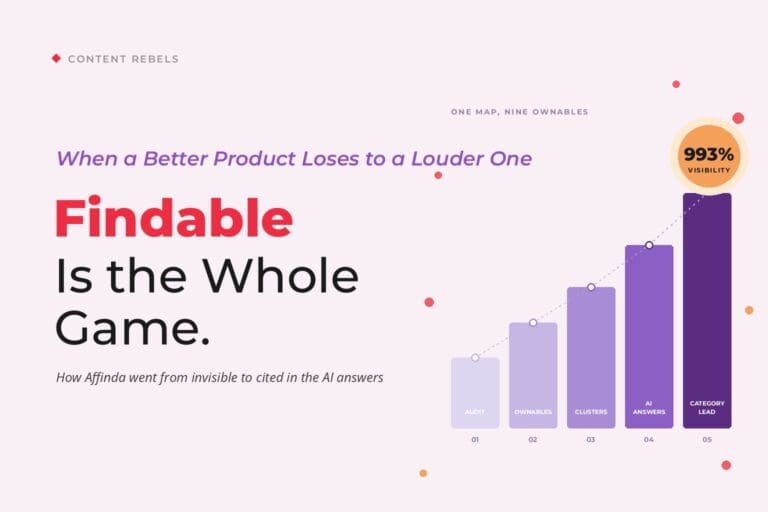
• 993% lift in high-intent search visibility, from 38 keyword phrases to 328.
• 182 Google AI Overview citations from a standing start
A walk through our award-nominated work for Affinda
A single long-form technical article cost Affinda’s marketing team 15 hours, which is two full working days spent on one piece of content while a whole category moved underneath them.
So Affinda built a human-led AI content engine its own team owns and runs, with expert humans in charge of every checkpoint. That build made Content Rebels a finalist in the 2026 Australian Marketing Institute Marketing Excellence Awards, in the Excellence in the Use of AI and Technology category. Here’s how it came together.
The challenge: a brilliant product, hand-cranked content
Affinda could do far more than the market knew. The platform reads more than 90 document types for some of the most demanding buyers in insurance, finance and logistics, and the gap between what it did and what buyers understood it did was widening by the month. For a business selling to careful, technical buyers, that invisibility was quietly costing real pipeline. In high-intent categories like ‘CV parser’, narrower competitors were winning. Not with a better product, because they did not have one, but by publishing more.
The window was also narrowing. The whole category was shifting from OCR to large language models, and first-mover authority in ‘agentic IDP’ would go to whoever built content authority fastest, across Google and the AI platforms buyers now ask first. At 15 hours an article, that pace was out of reach. Outsourcing would have bought volume and built dependency at the same time. So the brief got braver: build an AI content engine Affinda would own outright and run without an agency.
Enter Content Rebels.
Strategy first, engine second
Most AI content projects skip this part. The engine only works because the Search-First Strategy came first, and that strategy started with a dual-layered audit.
Layer 1: Performance diagnostics. Google Search Console and GA4 showed 32% of pages underperforming or absent, which set the repair list before anything new was written.
Layer 2: Competitive keyword analysis. SEMrush isolated the high-intent money keywords that narrower competitors were winning on searches with clear buying intent.
Fan-out Query Analysis then mapped how AI engines break a buyer’s big question into the smaller ones that follow it.
None of that stayed in a strategy deck.
- The money keywords became a live dataset the engine reads.
- The fan-out findings were codified into the drafting rules the agents follow.
- Every piece of research became a machine-readable input.
That is the difference between a strategy that informs the work and one that runs it.
The Ownables map that runs the whole thing
All that research converged into the Ownables (Semantic Entities) Content Map, a prioritised plan for the nine entities Affinda could credibly own. The map has a second job. It is the engine’s operating system.
Its fields are the engine’s inputs. When a marketer commissions a piece, the first agent’s compulsory fields come straight from the map.
- The Ownable the piece belongs to.
- The target persona and the decision they are making.
- The search intent behind the query it answers.
- The CTA goal the piece has to serve.
So every piece is strategically decided before a single word is drafted. The technology was not bolted onto the strategy. The strategy became the technology’s inputs. And the handover was written into the map from day one, with one goal. Affinda would run this alone.
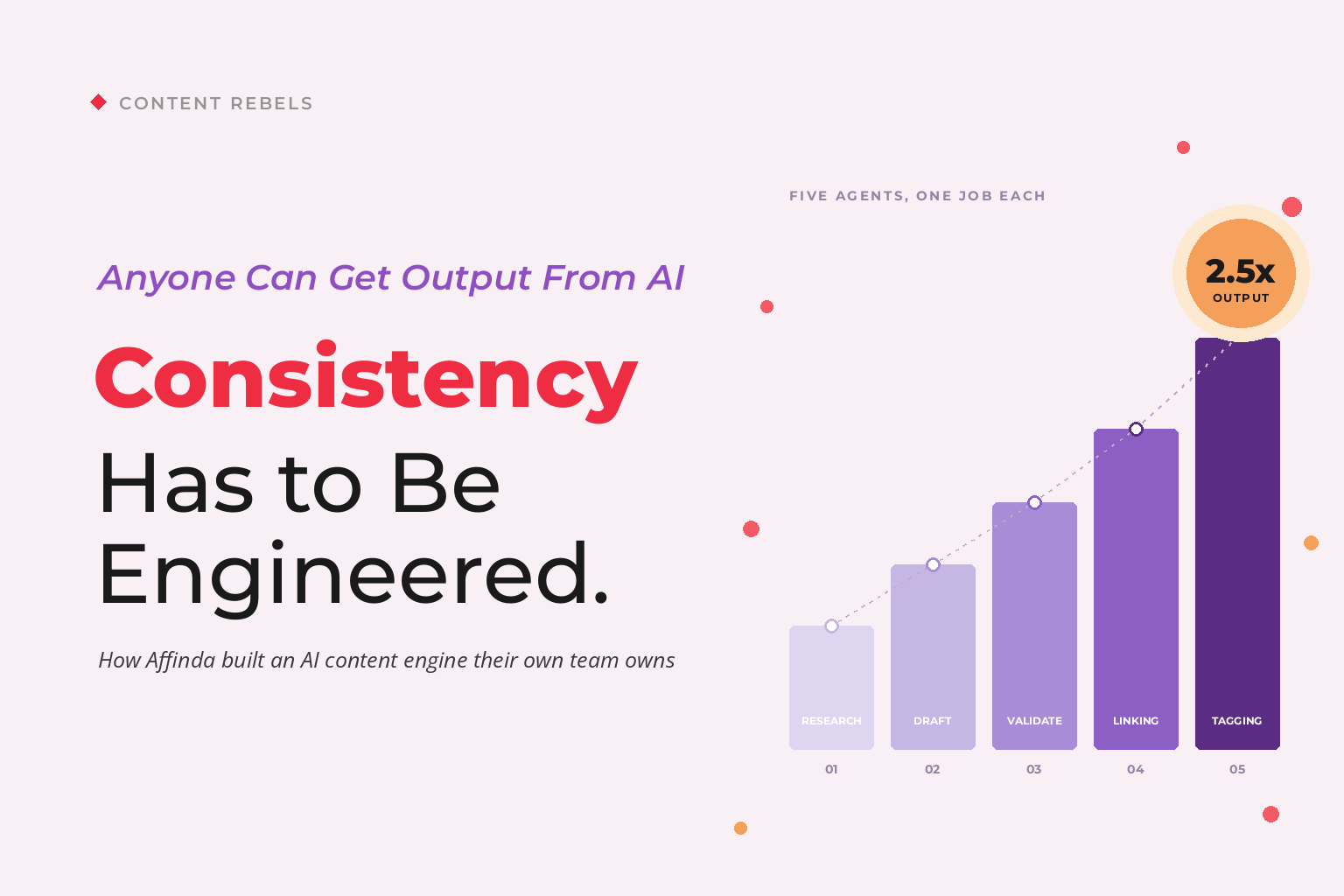
Five agents, one job each
Here’s what we didn’t do. We didn’t hand Interrelate 20 disconnected assets and call it a campaign. We were The engine is a pipeline of specialists, built on a simple principle. One AI platform asked to research, brief, write and refine will do all of it adequately and none of it well. So each agent gets one job.
Agent 1: Research and brief. Researches the topic and produces a 13-section brief.
Agent 2: Drafting. Writes the draft against that brief and nothing else.
Agent 3: Validation. Checks the draft against the brand rules and recommends changes.
Agent 4: Internal linking. Maps every phrase in the live keyword data to the draft and embeds links with a full changelog.
Agent 5: CMS tagging. Finishes the chain and readies the piece for publication.
Nothing moves between stages without explicit human approval.
Every agent also reads the ‘Affinda Brain’ before every task, four live documents covering the ICPs, the personas, the 2026 messaging framework and the tone of voice. Because those sources are live, the engine never drifts from what the brand actually says it is.
The hard part was codifying judgement
You can’t answer a question you haven’t heard. So we started by mapping how Australians search when they need Anyone can get semi-decent output from AI. Consistency has to be engineered. The real work here was not the technology. It was translating the judgement that normally lives in a strategist’s head into rules a machine can follow every single time.
Every prompt was treated like onboarding a new starter who has to get it right on day one.
- What does a flywheel position of ‘Attract’ change about the draft?
- When may the brand be mentioned?
- Which rules are locked, so the engine knows exactly where it is free to create?
Answer those in plain rules instead of vibes and the output stops depending on who wrote it or how their week was going. Before a human ever sees a draft, the engine checks it against the messaging framework, tone and ICP rules, with a clear order for what wins when they clash.
Built to be handed over
Affinda’s own team built and owns the engine. Content Rebels acted as the strategic architect and coach rather than the operator, setting the strategy, supplying the prompt-engineering frameworks and the codification rules, then sharpening the build through line-by-line prompt reviews and live working sessions with Affinda’s marketing and technical leads.
Every edit shipped with its reasoning, so the team learned the why and not just the what.
Governance was designed in rather than bolted on. Humans approve every stage, and the validation agent only ever recommends, it never overrides, which mirrors Affinda’s own ‘no black box’ philosophy. There is even a maturity path built in. Once its recommendations prove consistent, Affinda can graduate that agent to making changes automatically, with a full changelog and no loss of traceability.
No dependency. No black box. A system, transferred.
What the AI content engine delivered
The first return was speed. A long-form technical article that used to take 15 hours now takes 6, a 60% saving, with the human hours moved to where they matter most, strategy and technical accuracy rather than blank-page drafting. The same team now produces two and a half pieces in the time one used to take.
The second was consistency. Because every draft is validated against the live brand rules before a human sees it, quality stopped depending on the writer. When Affinda’s 2026 repositioning rolled out, the new messaging flowed through production automatically, because the agents read the brand’s live documents rather than a copy baked in months earlier. No retraining, and no stale drafts. If you want the strategy side of that story, the companion piece covers how Affinda won 993% more B2B search visibility.
And the speed bought depth. Run at full pace, the Search-First Strategy delivered results the old production model could never have supported.
- High-intent keywords grew from 38 to 328, a 993% lift in search visibility.
- 182 Google AI Overview citations from a standing start.
- By July 2026, 49 keywords sat at position #1 and 299 in the top 100.
None of that happens at 15 hours a piece.
The real measure of AI in marketing
We organised 12 months of work into four connected layers. Why four instead of one big push? Because each layer hThe gap between using AI and embedding AI is enormous. Plenty of teams have tried an AI writing tool. Far fewer have rebuilt their whole production workflow around one, with real governance, human oversight and a content architecture built for how AI search actually retrieves to feed it. Fewer still have done it in a way the client owns outright.
The AI did the volume. The humans set the standard. That is the real measure of excellence in marketing AI. Not which tool you use, but how much capability you are left holding when the project ends. Affinda finished running a system they understand, can explain and can extend on their own. That was always the point.
How Content Rebels turns Audit into Strategy
Content Rebels turns the audit into a Search-First Strategy by connecting visibility findings to Ownables, content systems and reporting.
Our Search-First Growth Strategy Audit looks at traditional search signals, AI Search visibility, competitor presence and content readiness. Then we show the first moves your team can make with the skills and tools already in the business.
The audit can point to a human-led AI Content Engine when the gap is production consistency. It can point to Generative Engine Optimisation when the gap is authority in AI answers. Or Marketing Reporting when leadership cannot see progress. We design, build and scale the response with documentation and training so your team grows stronger through the process. That matters because this work should build internal capability, not create permanent agency dependency.
‘The Content Rebels team are slick writers with a solid understanding of how to use AI well and produce content that wins in search.’
Aimee Amiga, AI-first Marketing and Comms Director, Affinda
Want to see what this kind of partnership could look like for your B2B business?
This work made us a finalist in the 2026 Australian Marketing Institute Marketing Excellence Awards for Excellence in the Use of AI and Technology, and it is the kind of partnership we have built for B2B clients like Inauro, MGI Australasia and ReStore for Retail. It also sits alongside our not-for-profit work with Interrelate, a finalist in the same awards.
If your content is stuck at hand-built pace while the window narrows on your category, there is a faster way that does not mean handing your brand to a black box. An AI content engine your team owns is the difference between borrowing capability and keeping it.
BOOK YOUR SEARCH-FIRST GROWTH STRATEGY AUDIT
Or, download our Search-First Strategy Playbook to see where a Search-First approach could take your team, or look at the Build-Your-Own AI Content Engine course if you would rather build it in-house from the start.
The B2B teams who build their AI content engine now will be the ones publishing at the speed their category demands.

Founder of Content Rebels | Proud marketing and strategy nerd