Why AI search engines matter for Brand Strategy now
Why AI Search Engines matter for Brand Strategy usually becomes clear in the worst possible room.
The CEO asks one neat question. The MD adds a competitor example. Someone mentions ChatGPT. Suddenly the senior marketer is expected to explain a search shift that has been moving in the background for months.
Why AI search Engines matter for Brand Strategy
AI search engines matter for Brand Strategy because they shape what buyers see before they click, enquire or shortlist.
Your brand is no longer judged only by the page someone lands on. It can be judged by an answer assembled from your site, competitor pages, trade media, reviews, social posts and whatever third-party proof the system can retrieve. That changes the brand job. Senior in-house marketers need to know which answers carry the brand, which answers ignore it and which answers describe the category without giving the brand a role.
That is why a Search-First Strategy starts with search behaviour and visibility, not a tool dashboard. The board doesn’t need theatre. They need a clean read on risk and response. That is the moment an AI Search Strategy becomes a Brand Strategy conversation, not an SEO side quest.
The boardroom question has changed
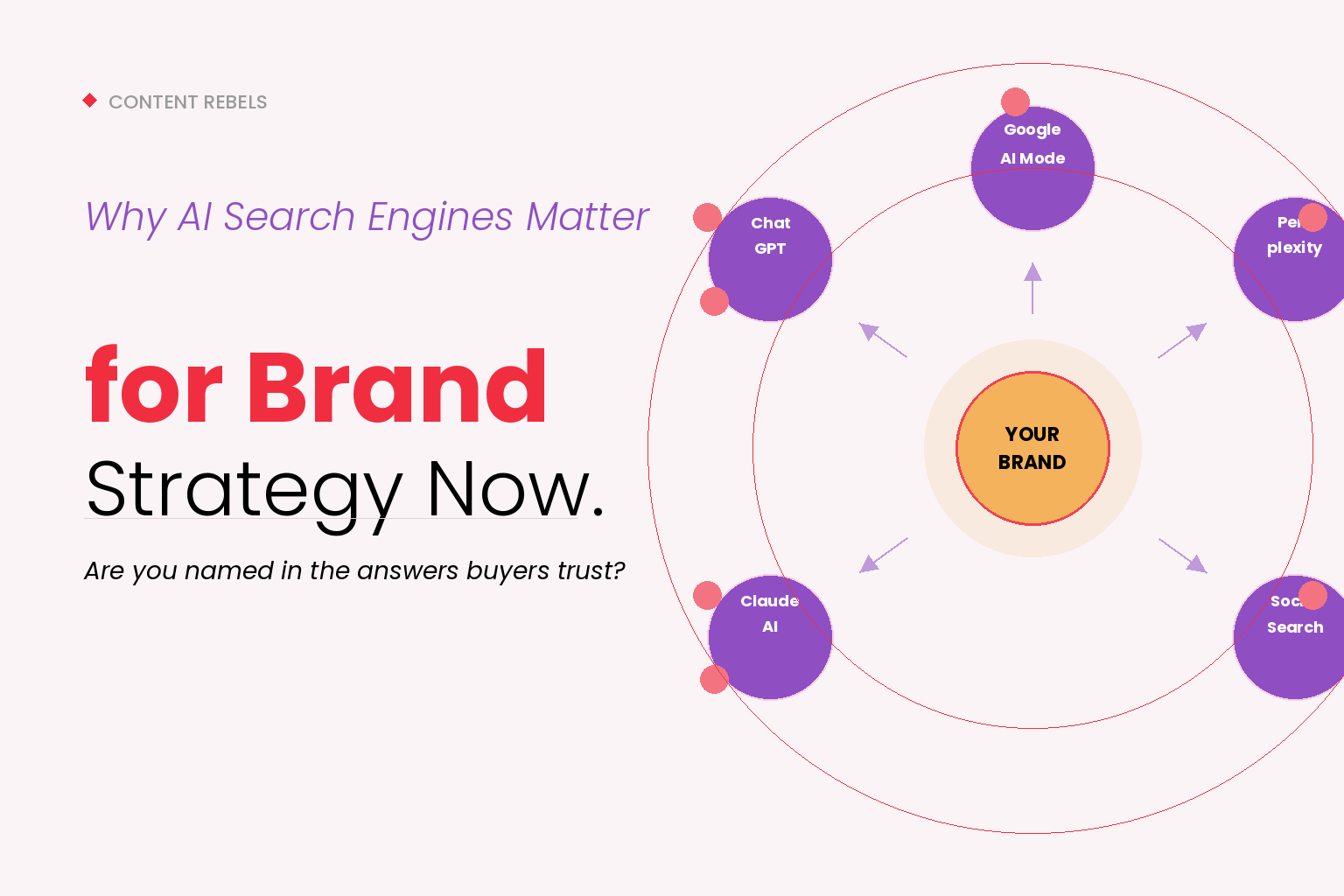
The leadership question used to be simple: how much traffic are we getting from search? Now the sharper question is: are we being named inside the answers buyers trust?
That is where the pressure comes from. Bain found that roughly 68 percent of LLM users rely on those platforms for researching, gathering and summarising information.
Translation: buyers can form a shortlist before they touch your site.
So the leadership conversation has to move beyond rankings. It needs visibility, Ownables, Share-of-AI-Voice and a plan that turns the signal into action. Not panic. Not vibes. A plan. The point is to make the room feel prepared, not entertained by another acronym parade.
[IMAGE: boardroom-ai-search-question.jpeg | “AI search Brand Strategy question in boardroom”]
Why do most AI Search answers fall over?
Most AI Search answers fall over because they start with the wrong fix.
- Some teams ask their SEO agency to retrofit the old model.
- Some buy an AI visibility tool and hope the dashboard writes the strategy.
- Some brief a tactical Generative Engine Optimisation freelancer.
- Some run DIY ChatGPT checks and then stare at the screenshots like they are waiting for them to become useful.
None of those moves is foolish. Each can show part of the problem. But each can miss the thing senior marketers need most: ammunition for a conversation, not another dashboard. The real job is to explain what changed, where the brand is visible and what the team will do next. That is the gap between evidence and advice. And it is where many rushed AI Search projects lose the plot.
Tools show symptoms, not strategy
AI Visibility Tracking tools can be useful for checks, prompts and trend lines. They can show where the brand appears, where competitors appear and which prompts return weak answers. Good. But tools do not decide what the brand should own. They do not translate findings into a leadership-ready narrative. They do not tell your content team which page, proof point or earned source should come first.
That’s why a Content Strategy for AI Search needs an engine and why knowing how to use AI search engine data for Brand Strategy matters more than the tool you choose. The data only becomes valuable when it changes a decision.
- Which Ownable deserves investment?
- Which category answer needs stronger proof?
- Which competitor claim should be challenged?
The dashboard cannot answer these questions by itself. It needs a strategist who can turn signal into priority, then priority into work the team can ship.
How should your response be framed?
A credible response starts with audience search behaviour. What are buyers asking in Traditional, AI and Social search? Which questions shape the shortlist? Which sources get cited? Which answers are wrong or thin or missing your brand entirely?
Answer these questions and the team can define Ownables and build a Search-First Content Ecosystem around them. That gives leadership a story they can fund: where the shift is happening, where the brand is exposed and what the next 90 days will change.
This is where AI search visibility strategies need to become more than reporting. They need to guide content structure, Digital PR and EEAT Authority plus sales enablement and Marketing Reporting Insights in one connected system. Otherwise the search shift gets split across channel owners. And nobody owns the actual brand answer.
A better answer for leadership
Better answers sound like this:
- We have started by mapping how our audience searches across Google, AI summaries and LLM tools.
- We are measuring where our brand appears, where competitors appear and where no credible brand answer exists.
- We are defining the Ownables we can credibly lead, then building content and proof around those areas.
- We are tracking Share-of-AI-Voice alongside Search Visibility and lead quality.
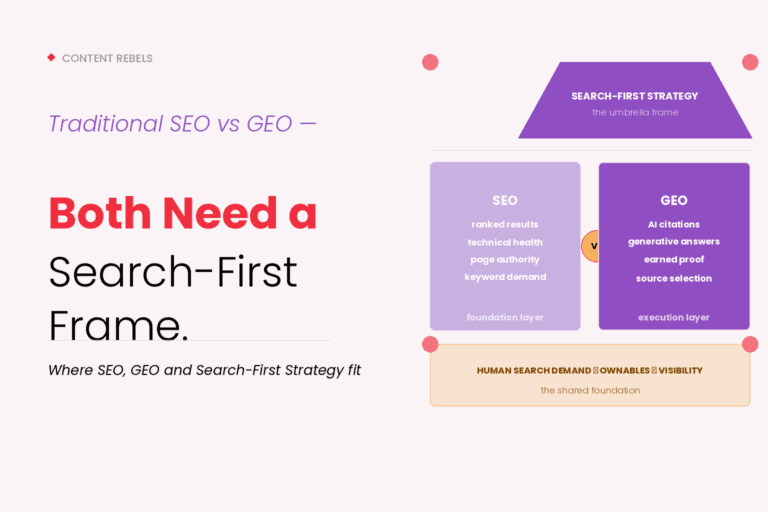
These answers give leadership a diagnostic, a commercial reason and a work plan. It also avoids the two traps that make marketers look reactive: pretending AI Search is a small SEO tweak or treating it like a reason to rebuild the whole team (it’s neither – traditional SEO vs Generative Engine Optimisation is a lot more nuanced than that). It is practical enough for the next meeting and strategic enough for the next quarter.
What should you do before the next meeting?
Prepare the baseline before the next meeting. Do not wait for the perfect tool stack. Do not wait for the market to settle down, because the market is not applying for a calming role in your quarterly plan.
You need enough evidence to brief the room and enough structure to show the next move. This is where the question of ‘what are best practices for AI Search Engine Brand Strategy?’ becomes a practical one. The best practice is not to chase every prompt. It’s to choose commercially useful prompts, connect them to buying moments and translate the findings into decisions the business can make. That might mean a new comparison page, a stronger case study, a PR angle or a better definition of the category.
Five actions for this week
- Collect 10 priority buyer questions across problem, comparison, shortlist and risk-reduction moments.
- Check those questions in Google, ChatGPT, Gemini and Perplexity to spot visible competitors.
- Classify every answer as brand cited, brand mentioned, competitor cited or brand absent.
- Define the first three Ownables your brand can credibly claim and support with proof.
- Report one simple Share-of-AI-Voice baseline so leadership sees the size of the gap.
Then package the findings into one slide and one action list. The slide should show the visibility gap. The action list should show what your team will do in the next 90 days. Keep it boring enough to approve. Boring gets bought when the room is nervous.
Make the answer board-ready
The board-ready answer needs three layers.
- The visibility baseline: where the brand appears and where it does not.
- The interpretation: what that means for brand trust, buyer confidence and sales conversations.
- The plan: which Ownables, content assets and authority signals get built next.
Keep it short enough to read in one slide. If the story needs 42 caveats and a live demo to make sense, it is not ready for leadership. Your job is to make the search shift explainable without flattening the problem into a toy version.
Hard? Yes. Worth it? Totally. A short, plain answer earns more trust than a glossy deck that hides the decision your team needs. Clarity beats theatre again, thankfully.
How Content Rebels turns the question into an audit
Content Rebels runs the Free Search-First Audit for senior in-house marketers who need the leadership answer fast. We look at Traditional and AI Search signals, competitor presence, Ownables and the visibility gaps that matter to demand generation. Then we turn the findings into a practical next-step strategy the team can present internally.
This is where the Content Rebels difference sits: tools show what AI says, but the audit explains what to do about it. Our client work has covered two decades of search shifts, from early Google updates to AI Search. Same discipline. New answer layer. We can connect the audit to an AI Content Engine when the findings show a content system gap.
The audit gives you ammunition
The Free Search-First Audit is built as ammunition for a conversation, not another dashboard. You get the visible gaps, the competitor context and the language to explain the shift without sounding panicked. It also links the findings to content work your team can actually run, not a fantasy rebuild of people, process and platforms.
That is important for Australian and NZ teams that already have brand rules, legal review, subject matter experts and stakeholder appetite to manage. We’re not here to make your team dependent on us forever. We give you the diagnostic, the next steps and the documentation to keep moving with calm in the chaos. That is the useful bit: capability transfer, not permanent agency dependence.
Your answer needs to be calm and specific
AI Search has made Brand Strategy more visible, not more mysterious. If the brand is absent from the answer layer, your team needs to know where, why and what to build. If competitors are being cited, your team needs to know which Ownables they are taking. If AI systems use stale or weak language, your team needs stronger sources for them to retrieve.
That is the real leadership answer. Not “we are testing AI Search”. Not “our SEO agency is across it”. The calm answer is diagnostic, specific and tied to action. It gives the senior marketer the room they need to lead the shift without making it a drama festival. Search has changed, but the job is still to help buyers find, trust and choose your brand.
[IMAGE: ai-search-boardroom-slide.jpeg | “Anonymised boardroom slide showing AI search audit findings”]
Need a cleaner answer for leadership?
Book the Free Search-First Audit and get a visibility diagnostic your team can take into the next CEO, MD or board conversation. We’ll show where your brand appears, where competitors are taking the answer and which Ownables should shape the first 90 days.
You’ll leave with language for leadership, not just a list of prompts. And your team will know what to build before the next meeting cycle starts. If the board question is already on your calendar, this is the shortcut that keeps everyone calm and specific before leadership asks again tomorrow. It also gives your next content brief a useful spine and your reporting a clearer story.

Founder of Content Rebels | Proud marketing and strategy nerd