What an AI Search Strategy means for Search-First teams
Your AI Search Strategy cannot start with a tool demo.
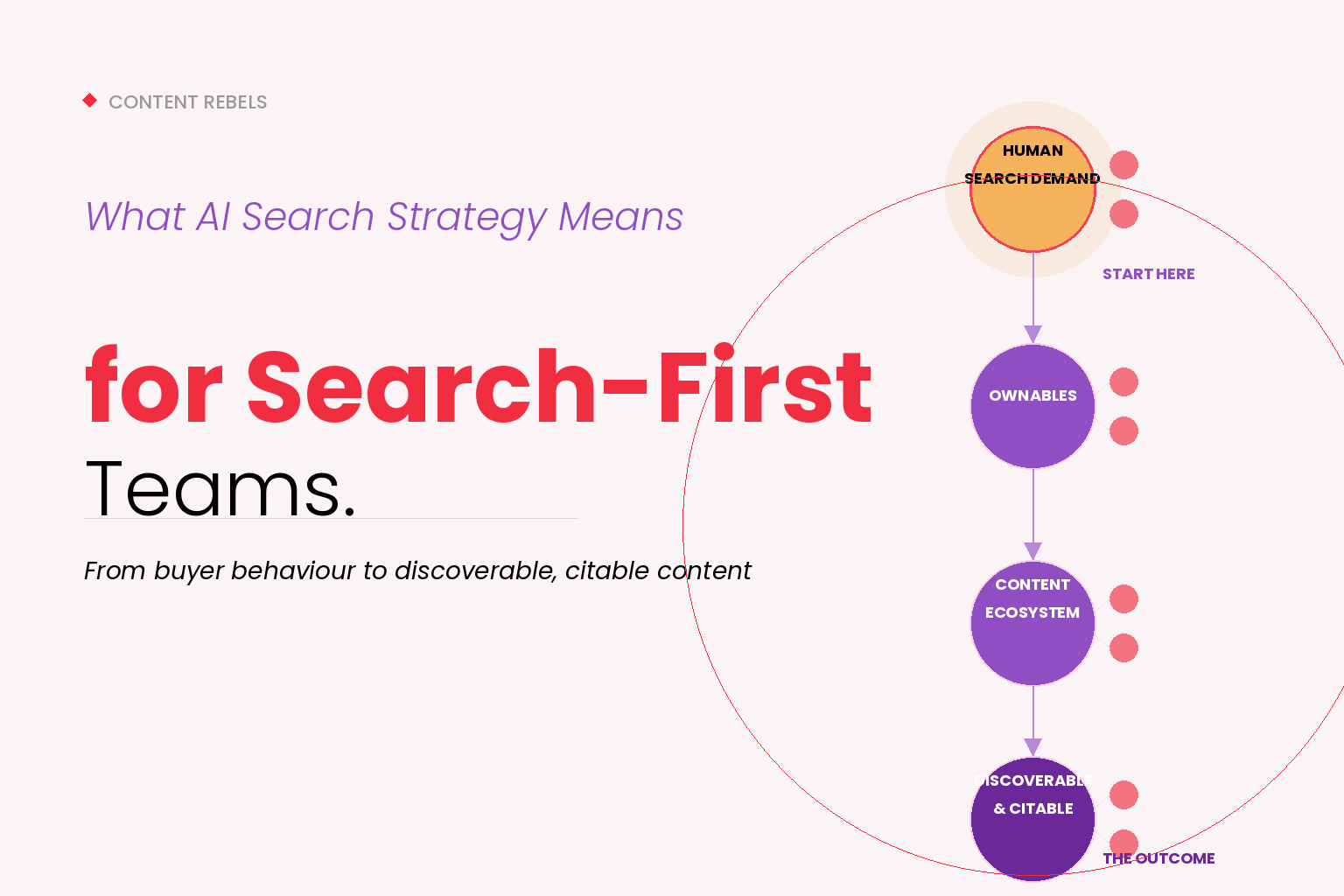
It starts with the human search behaviour your team is trying to serve. What are buyers asking? What do they need to believe? Which answers should carry your brand, not your competitor’s neat little claim parade?
What should an AI Search Strategy cover?
An AI Search Strategy should cover:
- the demand behind the query
- the ideas your brand can own
- the content signals that make those ideas visible across Traditional, AI and Social search.
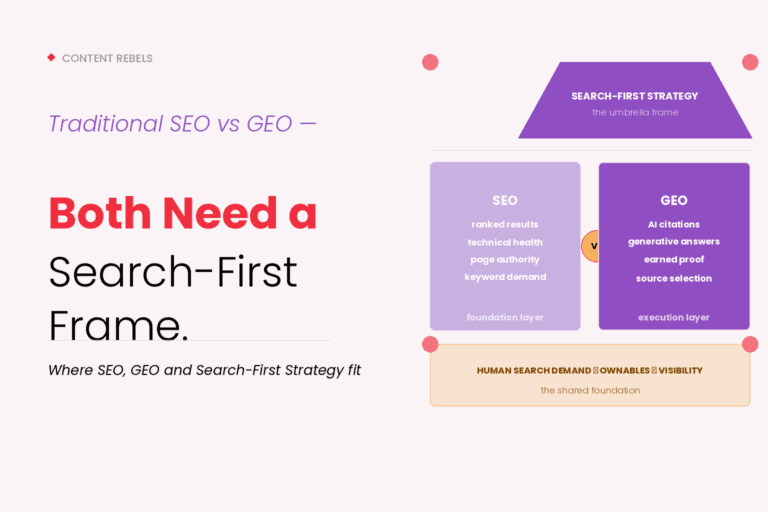
That means working from audience questions to Ownables, then building content that is Discoverable, Retrievable and Citable. It also means treating GEO as one execution layer inside Search-First Strategy, not the whole party.
We use a Search-First Strategy to connect search demand, Semantic Entities, owned content, earned proof and Marketing Reporting Insights into one operating model for in-house teams. Calm in the chaos. Useful, no? It also gives the team a filter for requests that sound urgent but do not help the brand get cited. Does the idea help the buyer find, trust or cite the brand? Does it support an Ownable? Does it answer a real search question? If not, it can wait.
Search starts with behaviour
Search-First work begins with what people are trying to work out before they choose. That might be a category question, a comparison, a risk question or a leadership-level brief they need to carry into the next meeting.
Google still matters here. StatCounter reports Google’s search engine market share at 90.02 percent worldwide for April 2026, so anyone telling you to abandon Google has wandered into the wrong marketing Olympics.
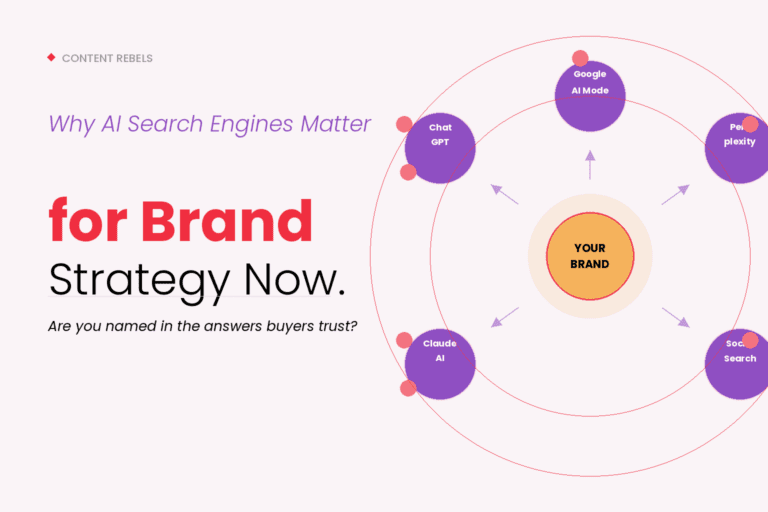
Translation: Traditional search still carries demand, but AI Search now shapes the answer layer around it. That’s why AI Search Engines matter for brand strategy now.
An AI Search Content Strategy has to read both signals without treating either as the whole story. That dual view stops the team from treating traffic drops as the only warning sign. In the trenches, that means your reporting needs to connect ranking data, AI citation checks, sales questions and content quality in one view. Otherwise each channel tells a different story and everyone argues over the wrong scoreboard.
That is the foundation of how to build an AI Search Optimisation Strategy.
Why does this matter to senior marketers?
It matters because brand perception now forms before the click. A buyer can ask ChatGPT for a shortlist, scan a Google AI Overview, check LinkedIn commentary and arrive on your site with half the decision already shaped.
Bain found that roughly 68 percent of LLM users rely on those platforms for research, gathering information and summaries.
Translation: your content can influence the room before your analytics records a visit.
That is excellent when your brand is cited. It is less excellent when the answer names three competitors and acts like you stayed home. That is why this is a leadership issue, not just a channel issue. The brand can lose consideration before a form fill ever gets the chance to exist.
For senior marketers, the risk is not embarrassment in a random prompt test. The risk is losing influence over the early shortlist, then trying to win the buyer back after their preferred answer has already formed.
Visibility beats channel panic
The wrong response is to chase every AI Search acronym that hits our shores.
What is generative engine optimisation? In practical terms, it’s the work of making your brand easier for generative systems to find, understand and cite. Useful. But limited. Without Search-First Strategy, it can become a tactical scramble around snippets, schema and prompt checks.
Senior marketers need a bigger answer because the CEO does not care whether the tactic is called GEO, AEO or Tuesday’s new acronym. They care whether the brand is visible where buyers now ask questions. And they care whether marketing has a plan that can be explained without smoke machines.
A useful plan turns messy platform change into a sequence:
- visibility baseline
- Ownables
- content gaps
- authority signals
- reporting.
That is why Share-of-AI-Voice belongs beside Search Visibility, organic traffic and lead quality. It gives the board a view of influence before the click and gives your team a reason to prioritise the content that changes that influence.
How Search-First changes the model
Search-First Strategy changes the model by moving the team from keyword-first publishing to meaning-led visibility. It asks what the brand should be known for, where that meaning must appear and how proof should travel across owned and earned sources.
This is where AI Search Engine Optimization strategies can get noisy. The search data may use US spelling, but the strategic job stays the same: connect the query to the decision.
For Content Rebels, that means building Ownables, strengthening Semantic Entity Mapping and using an AI Content Engine to repeat the right concepts with enough consistency that humans and machines can follow the thread. The system should make every page feel connected to the same commercial story. This is where a good Consistency Stack – the tone of voice and brand messaging a framework for keeping consistency across every page – earns its keep. It stops one team describing the offer one way, another team describing it another way and the website sounding like three brands in a trench coat.
The SEO and GEO shift
Here is the SEO/GEO to Search-First shift ourPlaybook is built around:
| Old search mindset | Search-First mindset |
|---|---|
| Keywords | Meaning |
| Pages | Search-First Content Ecosystems |
| Traffic | Visibility and conversion |
| Content pillars | Ownables |
| Static playbooks | Responsive 90-day experiments |
This traditional SEO vs Generative Engine Optimisation table looks simple because the point is simple. The operating model has changed. Pages still matter. Keywords still matter. But they now sit inside a wider search system where meaning, proof, entity clarity and off-site authority all affect whether a brand is retrieved.
Search Engine Land describes AI discovery as depending on semantic depth, retrievable structure, taxonomy, schema, internal linking and content chunking.
Translation: content structure is no longer formatting garnish. It is part of visibility.
If your best answer is buried in a vague paragraph, the machine layer may miss it and the human reader probably will too. It is also part of internal sanity, because a retrievable structure gives writers, reviewers and subject matter experts a shared shape to work from. Less interpretive dance. More system.
What should your team build first?
The temptation is to start producing. More blogs. More FAQs. More explainers. More work for everyone who already looks slightly haunted in Monday WIPs. Do not do that first.
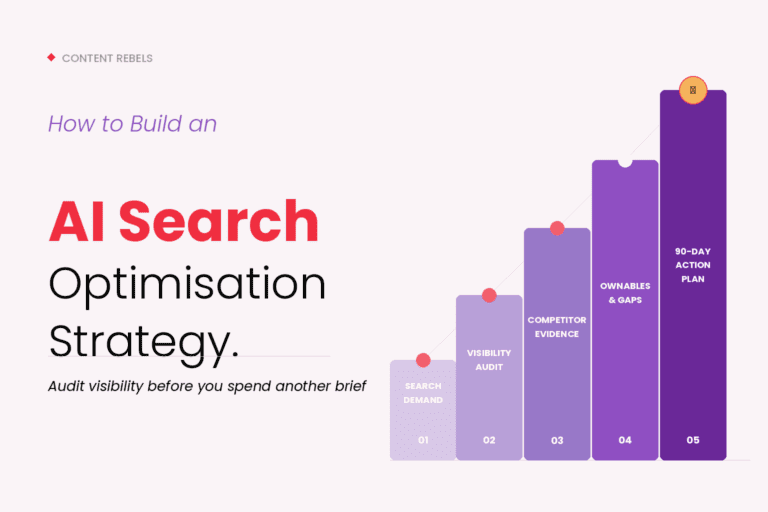
Your team should build the diagnostic before the content plan. So the useful order is audit, decide, build, measure and improve.
That sequence gives senior marketers the internal narrative they need and stops the team from producing content that closes no actual visibility gap. Use the Search-First Strategy Playbook as the first pass, then turn the findings into a 90-day experiment cycle. The goal is not a perfect content map. The goal is a first version the team can act on, test and explain. The play is not to build everything at once. The play is to decide which visibility gap matters most, build the content and proof around it, then measure what moved before the next cycle starts.
Five actions for this week
- Map the buyer questions your brand must answer across Traditional, AI and Social search surfaces.
- Define three Ownables your brand can credibly lead and repeat across owned and earned content.
- Audit your top pages for direct answers, source-backed claims and clear Semantic Entities.
- Compare AI answers against Google results to spot citation gaps, weak proof and competitor framing.
- Track Share-of-AI-Voice monthly so leadership sees progress beyond traffic and rankings.
These bullets are deliberately plain. Fancy strategy documents often collapse because nobody knows what should happen first on Monday. This list gives the team order. And order gives the strategy a chance to survive the week. Start small, but make the first move measurable.
Make the work small enough to repeat
For the first 90 days your team should not be trying to fix every search problem your brand has collected since 2014. Nobody has the time, energy and effort for that particular circus. Pick one territory and make the evidence unmistakable.
Choose the highest-value Ownable, the buyer questions attached to it and the proof needed to support it across owned and earned sources. Then build the minimum useful system around that territory.
- Which page answers the main question?
- Which comparison needs a table?
- Which case study carries the claim?
- Which expert quote can create authority outside your site?
Repeat the cycle once the first territory is live. That rhythm keeps the strategy from becoming a static deck that everyone admires and nobody uses. Repeatable beats heroic. Your team needs a cadence, not a content sprint that burns everyone out by week seven.
What the diagnostic gives leadership
A good diagnostic gives leadership three things they can act on:
- the current visibility baseline
- the commercial meaning of the gaps
- a short list of actions the team can fund or approve.
It turns the question from “are we in ChatGPT?” into “are we visible for the buying questions that matter?” Much better. It also protects the marketing team from random acts of content.
When every recommendation ties back to an Ownable, a query group or a Share-of-AI-Voice gap, the work stops looking like another campaign and starts looking like a search operating model. That is the level senior in-house marketers need when the room wants confidence, not theatre. It gives them ammunition for the next conversation, not a bigger spreadsheet.
How Content Rebels turns strategy into a system
Content Rebels helps teams design, build and scale Search-First Strategies for in-house teams that need a leadership-ready answer to fragmented search. We start with the visibility gap, define the Ownables, then build the content system, reporting layer and documentation the team can keep using.
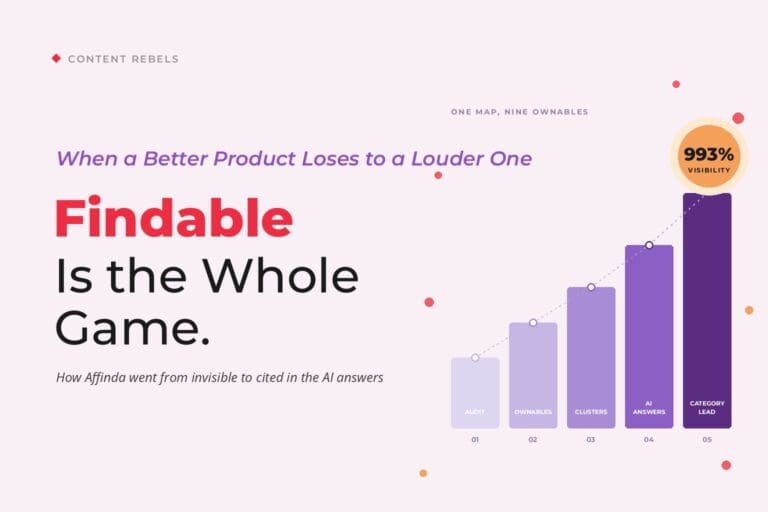
This is not a dependency play. Every engagement includes working notes, training and practical guidance so the in-house team gets sharper as the system gets stronger. Our work with healthylife produced a 157 percent Search revenue lift. For Affinda we lifted AI Search traffic by 87 percent.
Translation: the same framework can move across different markets when the search behaviour is diagnosed properly.
The proof matters because senior marketers need to defend investment with more than a fresh acronym and a hopeful forecast. The delivery changes by market, but the spine stays the same. Diagnose the search shift. Define what the brand can own. Build the content system. Transfer the operating notes back to the people who need to use them.
The Playbook is the starting point
The Playbook gives your team the four-step framework for finding the visibility gap through AI Visibility Tracking, naming what you can own and building the content engine around it. It is the low-friction first move for the senior marketer who knows the AI Search question is coming but does not want to walk in with tool screenshots and hope.
It also helps your team separate a Content Strategy for AI Search from a production wishlist. That matters because Search-First Strategy is a category-level operating model, not advanced SEO wearing a new hat. Very different outfit. It gives you the operating logic before you choose formats, which means your blog articles, landing pages, sales notes and expert content start working from the same brief.
The Playbook is useful because it turns the first conversation from “should we do GEO?” into “where are we currently invisible and what should we own?” That is a better question. It is also much easier to present to leadership without sounding like the team has joined an acronym cult.
Search has changed, but the job is clear
Search has not disappeared. It has changed shape. Buyers still want answers, proof, comparison, confidence and a reason to choose. The channels around those moments are more fragmented now, which makes the strategic spine more important. Your job is not to memorise every acronym. Your job is to know where demand is forming, what your brand can credibly own and what system will make that visible across Google, ChatGPT, Gemini, Perplexity and social search.
That is the difference between AI Search activity and Search-First Strategy. One gives you tasks. The other gives you a plan the room understands. And when the next search change arrives, the team has a way to respond without starting from zero. That clarity is the real point. Search-First Strategy helps the team keep the useful parts of SEO, add the right AI Search layer and avoid pretending a dashboard can make strategic choices for them. They will be the easiest to understand, retrieve and cite.
Need the Search-First starting point?
Use the Search-First Strategy Playbook to map your visibility gap, Ownables and first 90-day search experiments before your next planning round.
The Playbook is the cleanest starting point if you need to brief leadership, guide an agency or stop the next planning session becoming another alphabet soup tasting menu.
Start with the framework, then choose the experiments that fit your market, your team and your proof. It gives you a way to move from “we should look at AI Search” to “here is the visibility gap and here is the work we are doing next.” If leadership has already asked the question, this is the answer you can bring back without panic or prop comedy.

Founder of Content Rebels | Proud marketing and strategy nerd