How to humanise AI content
Right. Let’s settle this once and for all.
Every week I see the same question in my LinkedIn comments, my DMs, my client Slacks. How do you actually humanise AI content? What tools work? Which apps are worth the money? Is there a magic prompt nobody’s shared yet?
The answers people get back are almost always the same. Run it through Quillbot. Try Undetectable AI. Use Humbot. Stealth Writer. Whatever the new one is this month.
I’ve tested all of them. I’ve spent four years in the trenches making AI write like an actual human for clients across financial services, eCommerce and B2B SaaS. Here’s what I can tell you with full confidence.
You cannot humanise AI content after the fact.
You can ONLY stop it producing slop in the first place.
That’s a system. Not a tool. And no, I’m not saying that to upsell my course. I’m saying it because every shortcut I’ve tested fails for the same structural reason. Once you understand that reason, the way forward gets very clear, very fast.
Let’s get into it.
What ‘humanise AI content’ actually means (and why the tools selling it can’t deliver)
When marketers say they want to humanise AI content, they usually mean one of three things:
- Stop it tripping AI detectors.
- Stop it sounding like a polite robot.
- Stop it sounding like every other AI-generated piece on the internet.
Detection-only humanising is a losing game. Detection models update faster than humaniser apps can keep up. What worked last quarter won’t work this quarter and you’ll be paying for the next subscription before long.
But the bigger problem? Even if you trick a detector, you still have content that reads like a polite robot who’s never met an actual human. Your audience clocks it instantly. They might not be able to name what’s wrong. They feel it.
So why do humaniser tools fail at the actual job? Because of what AI does when it ‘writes’.
It doesn’t write. It predicts.
Every word output by ChatGPT, Claude, Gemini or Perplexity is the statistically most probable next word, drawn from a training set heavy on academic journals, corporate documentation, encyclopaedia entries and 19th-century literature. That’s the baseline. That’s the default. That’s slop.
Now stack RLHF on top [Reinforcement Learning from Human Feedback for those playing along with the Acronymn Olympics at home] During training, humans penalise outputs that are strong, definitive or controversial. So every model has a deep mathematical compulsion to never fully commit to an opinion. Bold statements get hedged. Claims get softened. Disclaimers get sprinkled in like garnish.
A humaniser tool comes along and what does it do?
Swaps a few synonyms. Splits a few sentences. Adds a typo.
The skeleton is still robotic. The structure is still mathematically safe. The hedge is still in. Detection tools will catch it again next month, and your readers caught it the first time round.
You cannot synonym-swap your way out of how a model thinks.
AI vs human content (the actual difference)
Here’s the bit that kills the ‘humanise it later’ fantasy.
A human writer instinctively knows who they’re writing for. So they don’t hedge. They take a position. They use vocabulary their reader already uses. They leave out things their reader already knows. The output is short, sharp, specific.
AI? It doesn’t know any of that. Even if you’ve uploaded an ICP doc. Even if you’ve told it ‘write for marketing managers’. Even if you’ve spent three hours building a custom GPT with your tone guide attached?! Still no. So it casts the widest possible semantic net… and writes for everyone. Which means it writes for no one.
That’s the actual gap in AI vs human content. Not punctuation. Not vocabulary. Not even structure. It’s specificity. It’s commitment. It’s a writer who knows their reader.
So how do you humanise AI content properly? You give the model so much strategic and stylistic context up front that it CAN’T fall back on generic. You’re pulling it away from its mediocre norm before it generates the first word.
That’s a system. Not a tool.
How to humanise AI content manually (the checklist I followed for two years before I built the Engine)
OK so what if you don’t want a system yet? What if you just want to fix what AI gives you, manually, draft by draft?
Fair. It’s possible. Here’s the actual checklist I used for two years before I designed and built any AI Content Engines. Run every AI draft through this and the drift becomes obvious.
Punctuation surgery.
- Strip every em dash. Replace with full stop, comma or parens. No exceptions.
- Kill colon-cascades. If a paragraph has two colons, rewrite. If a title is hook-colon-explanation, rewrite.
- Kill semicolons. Split into two sentences.
Vocabulary cleanse.
- Find and delete (or rewrite around): delve, tapestry, vibrant, bustling, robust, ever-evolving, crucial, paramount, unprecedented, holistic, leverage, harness, foster, elevate, navigate the complexities, shed light on. Build your own banned list. There are more.
- Replace ‘plays a vital role’ / ‘is a pivotal’ / ‘stand the test of time’ / ‘in today’s fast-paced world’ with literally anything specific.
- Cut every ‘whether you’re a seasoned X or a curious Y’ construction. Address ONE reader directly.
Structural surgery.
- Find every negation pivot (‘X isn’t just Y, it’s Z’). Rewrite affirmatively. Say what it IS, not what it isn’t.
- Find every ‘However, it’s important to note that…’ hedge. Delete it or fold the genuine caveat into the original sentence.
- Find every ‘Ultimately,’ / ‘In conclusion,’ / ‘Furthermore,’ / ‘Moreover,’ sentence opener. Cut the transition. The sentence stands.
Voice surgery.
- Read the whole thing out loud. Wherever you wince, rewrite. Wherever it sounds like a corporate annual report, rewrite. Wherever it could have been written by anyone for anyone, rewrite.
That’s the manual approach. It works! I’ll be honest with you. It also takes 45 minutes per blog post. And you have to do it every single time. For every writer on your team. For every piece of content. Forever.
Tired yet? Same.
Which is exactly the problem.
How to convert AI content to human content at scale (you don’t, you change what gets generated)
Here’s the thing about manual editing. It works for one blog. Maybe ten. By blog 50 you’ll be skipping rules. By blog 100 you’ll be back to slop. And if you’ve got a team? Forget it. Each editor will apply the rules differently. The brand voice will drift across writers, across weeks, across content types.
Trying to convert AI content to human content piece by piece is a tax on your most valuable resource. Your team’s time, energy and effort. Or your own.
So how do you convert AI content to human content at scale? Honest answer? You don’t. The framing is wrong. You’re not converting bad output into good output. You’re moving the rules out of your head… and into the system.
You don’t convert the output. You change what the model produces in the first place.
That’s where the AI Content Engine comes in.
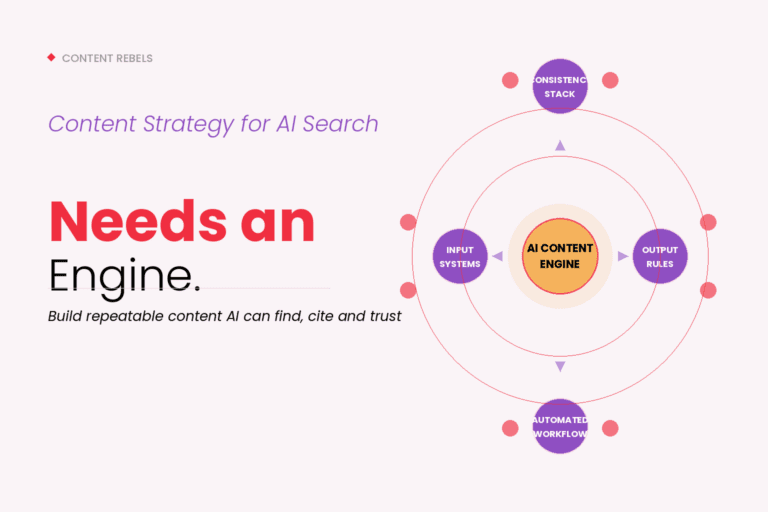
The fix is an AI Content Engine (3 pillars, working together)
You need a system. Not a single prompt. Three pillars working together, each closing a gap that humaniser tools and manual edits can’t touch on their own.
Pillar 1: The Consistency Stack (your voice, codified)
The Consistency Stack is how you turn your tone of voice into something the AI applies every output, every time.
Most marketers think they’re already doing this because they’ve uploaded a brand voice PDF to a custom GPT or project. Cool. Doesn’t work. A PDF informs the model. System instructions instruct it. Massive difference.
Inside a proper Consistency Stack you’ve got six sections, all written in XML so the model knows exactly what to do with each:
- Tone of Voice dimensions (formal vs casual, serious vs funny, respectful vs irreverent, with positive AND negative examples for each).
- Writing mechanics (sentence length, active vs passive, rhetorical questions, paragraph rhythm, punctuation rules).
- Brand vocabulary (signature phrases, words you own, capitalisation rules).
- Negative constraints (banned words, banned punctuation, banned sentence patterns. Em dashes? Absolutely not).
- Few-shot examples (positive and negative samples in your voice. Models learn faster from contrast than instruction).
- A verification loop (the bit that tells the AI to check its own draft against your rules before it outputs anything).
That last one is the cheat code most people miss. The verification loop is why a Consistency Stack beats every humaniser tool, every manual edit pass, every well-meaning brand guidelines PDF on the planet. The model cleans up after itself before the draft ever reaches you.
Translation: every rule in your manual checklist above gets baked into the system once. Then runs forever. No more 45-minute edit sessions. No more drift across writers.
Pillar 2: Output Rules (your structure, codified)
A blog post is not a LinkedIn post, is not a Google ad, is not an email. Each one has completely different structural DNA.
Most people ask AI to build furniture with no instructions. Output Rules are the IKEA instructions.
Per format you codify: structure, length, hierarchy, internal linking patterns, character counts, hook formats, CTA conventions. So when you say ‘write me a LinkedIn post’, the AI doesn’t reach for a generic LinkedIn post template. It reaches for YOUR LinkedIn post template.
Pillar 3: Input Rules (your strategy, codified)
This is the pillar most people skip. Then wonder why their AI content still feels generic.
Even with a perfect Consistency Stack and Output Rules, if you say ‘write me a blog about lead generation’, you get a blog about lead generation for the average business. Not yours. Why? Because the AI doesn’t know your business, your audience, your competitors or your differentiators. So it fills the gaps with statistical averages. Generic pain points. Generic advice.
Input Rules are the data packet that sits in front of every piece of content you create. Strategic foundation (business objective, value prop, success metrics). Audience and market context (ICP, voice-of-customer pain points, competitor URLs, differentiators). Plus executional parameters and governance.
Feed all of that into the model before you ask it to write a single word, and the output shifts entirely. It’s not filling gaps with statistical averages. It’s writing from your actual strategic position.
That’s the real difference between AI vs human content. And no humaniser app, no manual edit pass, no clever prompt can manufacture it after the fact.
What tool can I use to humanise AI content? (it’s not one tool, it’s four)
If you’ve been searching for the best tool to humanise AI content, here’s the honest answer. There isn’t one. There are four, each doing the job they’re actually built for. None of them are ‘humaniser’ apps.
This is the four-tool stack we use with clients and the one I teach in the course.
1. Research → Perplexity. Perplexity Deep Research analyses hundreds of sources and gives you clickable citations. Which means the system is fed real, current, verifiable context. Not the hallucination-prone training data inside ChatGPT or Claude.
2. Briefing → ChatGPT (Canvas). ChatGPT’s Canvas interface plus its Memory feature makes it the best ‘collator’. Faster at brainstorming 20+ headlines or structural outlines than Claude. Memory means it remembers your brief templates across days. Less context-rebuilding every Monday morning.
3. Drafting and editing → Claude. Claude (Sonnet and Opus) is the writer’s AI. Benchmarks show a 93% satisfaction rate for natural conversation and prose that doesn’t sound AI-generated. Translation: Claude is the model that actually obeys ‘Style Don’ts’ like ‘don’t use corporate jargon’. ChatGPT will nod and keep using corporate jargon. Claude will stop!
4. Go live → Copilot Cowork or Gemini Agents. These have line of sight into your email and calendar, which means they route stakeholders for review without you sending a single message manually.
Four tools. Each playing its position. That’s the engine!
Notice what’s NOT on that list? Quillbot. Undetectable AI. Humbot. Any of them. Because once your Engine is running, you don’t need to humanise the output. The output never sounded like a robot to begin with.
What to do this week
If you’re starting from zero, pick ONE pillar. Just one. Build it properly before you move to the next.
Most marketers try to do all three at once and end up with a half-baked Consistency Stack, a vague set of Output Rules and no Input Rules at all. That’s not a system. That’s a folder full of PDFs!
Start with the Consistency Stack. Easiest to begin, biggest payoff. Get your voice codified in XML system instructions. Drop in five negative constraints from the manual checklist above. Run a single piece of content through it. Compare it to your last AI draft. The gap will tell you everything.
Or… (dare I say it again) skip the figure-it-out phase entirely.
We run the Build-Your-Own AI Content Engine course. Eight weeks. Weekly live build sessions. $15,000+ of tried-and-tested templates. Four bonus office hours. A WhatsApp support group for when you’re stuck on a deadline.
The marketers who design, build and scale their Engine this year will spend 2026 producing on-brand content at scale while everyone else is still pasting drafts into Quillbot and praying. Don’t be late to the party.

Founder of Content Rebels | Proud marketing and strategy nerd