How to build an AI Search Optimisation Strategy
For many brands, learning how to build an AI Search Optimisation Strategy becomes urgent after the traffic graph starts looking rude.
Organic traffic slides for a quarter. AI Overviews appear in more results. Someone asks what ChatGPT says about the brand. Suddenly the content plan looks less like a plan and more like a guess wearing a lanyard.
Start with visibility, not content
Build the AI Search Strategy by auditing visibility before producing more content. That means checking:
- what buyers search
- where your brand appears
- which competitors get cited
- which trends are changing the answer layer
- what the findings mean for your next 90 days.
This order matters. You cannot build a Search-First Strategy on assumptions and expect the AI layer to politely fix the gaps.
The audit gives senior marketers the baseline: where the brand is visible, where it is missing and where the answer is being shaped by someone else. It also stops the team from confusing output with progress. More content only helps when it closes a real visibility gap. That is the point of the audit: fewer assumptions and cleaner choices. Otherwise, the team just ships harder into the wrong problem.
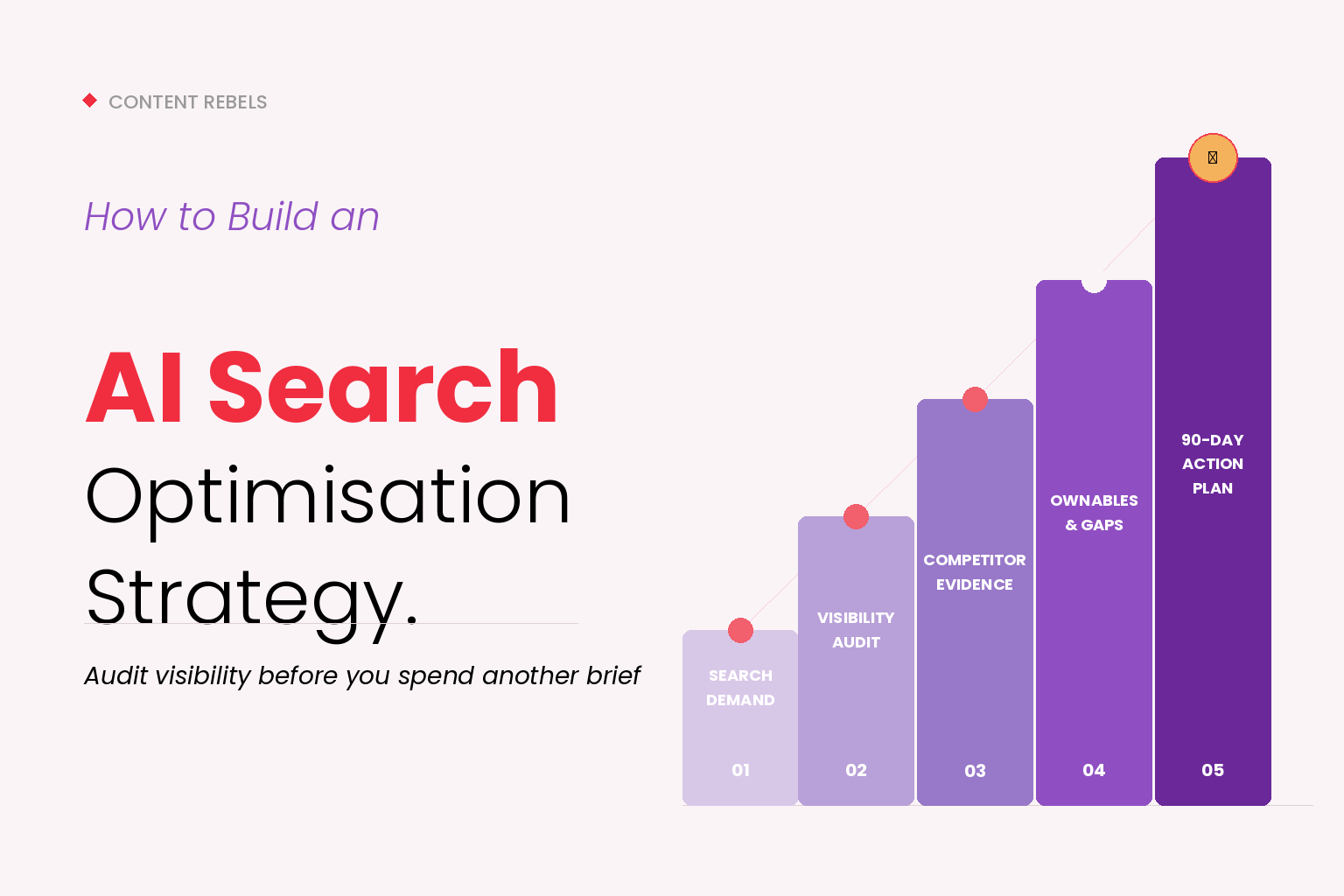
Step 1 Conduct Search Demand Research
Search Demand Research shows what people are trying to work out before they choose. Start with buyer questions across problem recognition, category learning, comparison, shortlisting and risk reduction. Then group those questions by intent, not by keyword vanity.
- What does the buyer need to know?
- What language do they use before they understand your category?
- Which questions carry commercial intent?
This step sets up the AI Search Strategy because it gives the team a demand map instead of a prompt list. The goal is to find the search moments your brand should own, then connect those moments to Ownables, proof and content. If the team skips this step, the audit becomes a random sample of AI answers.
Why audit before more content?
Audit before content, because the visibility gap may sit somewhere your content calendar is not looking. Bain found that about 60 percent of traditional searches now end without the user clicking through to another website.
Translation: your buyer may be influenced before the visit.
A page can look fine in analytics and still fail to appear in AI summaries, comparison answers or category explanations. That’s why AI Search Visibility Strategies need to start with Traditional and AI platforms together. Google still matters. AI answers now matter too. The audit keeps both in view without turning the project into channel panic. It gives the team calm in the chaos before production starts again.
Step 2 Run a Visibility Audit
The Visibility Audit checks where the brand appears across Traditional and AI platforms.
For Traditional search, classify priority queries as Top 10, SERP Feature, #11-#100 or unranked.
For AI Search, classify each prompt as brand cited, brand mentioned, competitor cited, answer inaccurate or brand absent. That gives the team a shared language for the gap. It also shows where existing SEO strength carries over and where it does not.
A 2026 arXiv study of Google AI Overviews found overall activation at 13.7 percent, rising to 64.7 percent for question-form queries. Translation: question-led content can affect the chance that your brand enters the answer layer at all.
What competitor evidence changes the plan?
Competitor evidence changes the plan when it shows who gets the answer instead of you. This is where the audit stops being abstract and starts getting personal.
- Which competitors are cited across ChatGPT, Gemini and Perplexity?
- Which third-party publications appear repeatedly?
- Which comparison pages carry the category language?
- Which sources reinforce a competitor’s claim?
The point is not to copy competitors. The point is to see the authority pattern the AI systems are using. If the same sources keep shaping the answer, your content plan needs to include owned content and earned proof. Otherwise the team keeps publishing into the wrong part of the system. Not fun, not cheap. This is the moment the audit starts saving budget, not just finding problems.
Step 3 Carry out a Competitor Scout
A Competitor Scout maps who appears where your brand should appear. Record competitor mentions, cited sources, repeated claims, proof types and content formats. Then ask better questions. Are competitors winning because they have:
- clearer definitions?
- stronger case studies?
- better third-party coverage?
- more comparison content?
This is where measuring the effectiveness of AI Search Strategies gets practical. You’re not measuring volume for sport. You’re measuring the brand’s presence in the answer moments that support demand.
Use Share-of-AI-Voice for tracked prompts, then connect that signal to lead quality, sales questions and Search Visibility. That gives leadership a more useful story than traffic alone. It also gives the content team a target that is sharper than “publish more”.
Which trends deserve a sense-check?
Sense-check trends so the team does not build around one strange screenshot. AI answers can vary by phrasing, time, location, account state and platform. Search trends can also be noisy. The useful move is to compare multiple sources: Google Search Console, analytics, paid search data, sales-call themes, social search cues, AI answer checks and credible third-party research. The principles behind effective AI Search optimization are the same regardless of market: decide what is real enough to act on.. Look for repeated patterns. Ignore one-off weirdness. The audit should reduce noise, not make the marketing team start collecting screenshots like rare trading cards. The sense-check keeps the work grounded in repeatable evidence, not platform theatre.
Step 4 Sense check Search Trends
Search Trends Sense-Check asks if the pattern is consistent enough to shape work. One odd AI answer is not a strategy brief. Look at query shifts, AI Overview presence, zero-click pressure, prompt stability and competitor movement.
StatCounter shows Google still held 90.02 percent worldwide search engine market share in April 2026.
Translation: Traditional search remains a major demand signal, even while AI Search changes how answers appear.
Use that balance. If organic traffic is sliding, check if demand has dropped, SERP features have changed, AI answers are absorbing the click or competitors are taking the category answer. Each cause points to a different response. Same graph. Different work. That distinction is where many rushed content fixes fall over.
How should you run the audit?
Run the audit in a tight sequence and keep each step tied to a decision. The goal is not a giant spreadsheet that everyone respects and nobody uses. The goal is to turn visibility evidence into a 90-day plan.
This is where Search-First Marketing Strategies gives the audit its spine. The team can see what buyers ask, where the brand appears, which competitors are shaping answers, which trends are real and what needs building next. Keep the work small enough to repeat. That is how you avoid a one-off diagnostic that gets admired in a meeting and then quietly buried under the next content calendar. Use the Search-First Growth Framework to keep the audit tied to decisions.
Step 5 Collate Insights
Insights Collation turns findings into a leadership-ready story. Summarise the visibility baseline, priority gaps, competitor patterns, first three Ownables, content actions, earned authority needs and reporting measures. Then write the 90-day plan in plain language. Which page gets created?
- Which page gets rewritten?
- Which proof point needs a better source?
- Which expert point of view should be published?
- Which third-party mention would strengthen the answer?
Keep the sequence clear. Visibility first. Meaning second. Action third. This is the step that gives senior marketers ammunition for a conversation, not another dashboard. It also tells the content team what to do next Monday. Lovely. The output should be plain enough for fast action. It turns a messy visibility problem into work a team can brief, assign and measure.
Use these classifications
- Label Traditional results as Top 10, SERP Feature, #11-#100 or unranked for each query.
- Classify AI prompts as cited, mentioned, competitor cited, inaccurate or absent across platforms.
- Group gaps by Ownable so the work builds brand territory instead of scattered pages.
- Prioritise gaps by commercial intent, proof strength and how fast the team can act.
- Report Share-of-AI-Voice with Search Visibility so leadership sees influence before clicks.
This list should become the operating language for every audit review, content brief and leadership update.
Keep the language consistent across the audit. If one person calls a query unranked and another calls it absent, the data gets messy fast. Boring labels are your friend.
How Content Rebels turns Audit into Strategy
Content Rebels turns the audit into a Search-First Strategy by connecting visibility findings to Ownables, content systems and reporting.
Our Free Search-First Audit looks at Traditional search signals, AI Search visibility, competitor presence and content readiness. Then we show the first moves your team can make with the skills and tools already in the business.
The audit can also point to an AI Content Engine when the gap is production consistency. It can point to Digital PR when the gap is authority. Or reporting when leadership cannot see progress. We design, build and scale the response with documentation and training so your team grows stronger through the process. That matters because this work should build internal capability, not create permanent agency dependency.
Want a shortcut?
The shortcut is not skipping the diagnostic. The shortcut is getting the diagnostic done properly before you spend more on content. Our Free Search-First Audit gives you the visibility baseline, competitor context, Ownables opportunities and next-step plan without forcing your team to become a temporary search lab.
It is built for senior marketers who need to answer leadership with calm in the chaos.
- Where are we visible?
- Where are competitors being cited?
- Which questions are we missing?
- What should we build first?
The audit gives you a clear answer for the room and a practical brief for the team. It keeps the discussion focused on the work that can move visibility, not the noise around the newest feature. It is the shortcut that still respects the diagnostic.
The audit is the foundation
An AI Search Optimisation Strategy should begin with visibility. Once you know where the brand appears, where it is absent and which sources shape the answer, the content plan becomes much sharper.
- You can brief pages that answer real questions.
- You can strengthen proof where AI systems need better sources.
- You can build Ownables instead of random articles.
- You can report progress before traffic tells the full story.
This is how in-house marketers keep the work strategic without turning it into panic bait. Audit first. Then build. Then measure. Then repeat. That rhythm is how the work becomes manageable for an in-house team that already has enough tabs open. That rhythm is how the Strategy stays alive after the first workshop.
Need to know the visibility gap before more content?
Book the Free Search-First Audit before the next content plan locks. We will show where your brand appears across Traditional and AI Search, which competitors are shaping the answer and which Ownables should guide the first 90 days.
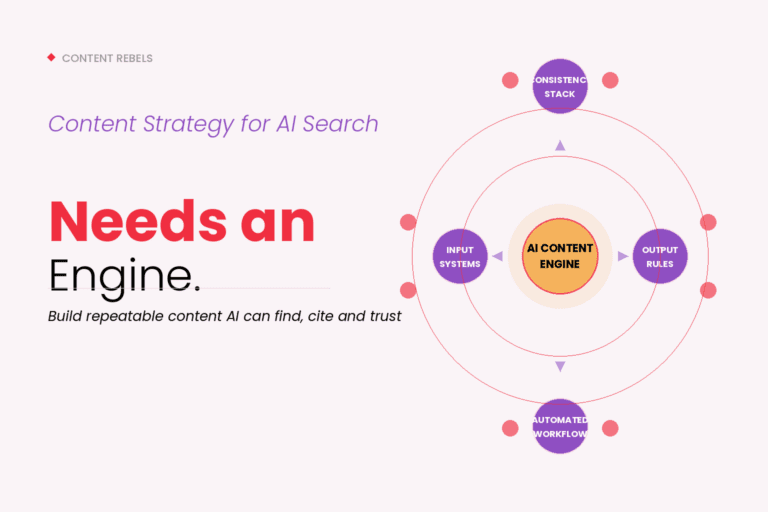
The output gives leadership the baseline and gives your team the next brief. If organic traffic has slid, AI Overviews look suspicious and nobody knows what AI is saying about the brand, start here before another dollar goes into production. This is where a Content Strategy for AI Search starts to behave more like an engine than a set of disconnected decisions. The diagnostic gives your next content plan a spine and gives leadership the answer they are already trying to get from the team. The audit keeps the next brief tied to evidence. And that saves time, energy and effort when everyone is already busy.

Founder of Content Rebels | Proud marketing and strategy nerd