How we helped 1,168% more Australians in need reach out to Interrelate via not-for-profit SEO
AT A GLANCE
Award Recognition: Finalist – 2026 Australian Marketing Institute Marketing Excellence Awards (Not-for-Profit Marketing)
The Challenge: Grow search engine visibility and traffic for a 100-year-old charity so they could be found by more Australians who are in need of their services.
Key Results:
• +1,059% organic sessions (10,824 total)
• +1,168% enquiry-intent conversions (596 total)
• $30k–$60k saved in equivalent Google Ads spend
• 6/6 articles landed in Google AI Overviews within 30 days

A walk through our award-nominated work for Interrelate
Separation. A mental health crisis. Family violence. When someone types one of those searches into Google at their lowest moment, the result they land on can mean the difference between getting help and giving up.
For a century, Australian relationship support service provider Interrelate has offered real help, but Australians in crisis were consistently directed to competing organisations instead. Here’s how we turned it around for Interrelate and the steps we took to land a finalist spot in the 2026 Australian Marketing Institute Marketing Excellence Awards, Not-for-Profit Marketing category.
A century of trust, nearly invisible online
Interrelate turned 100 in 2026. A hundred years of frontline relationships and mental health work, built on trust that most organisations can only dream of. So where was all that trust when Australians actually searched for help? Nowhere near the top of the search results.
Instead, people found competitors. Well-funded corporate and for-profit providers with years of SEO budget banked, sitting above a century-old charity on the searches that mattered most. So, people would reach out online for support, find a slick corporate page and the organisation that has quietly done this work for decades wasn’t showing up.
After a new website and brand refresh in 2025, Interrelate hit a crossroads. The trust was there, but the digital foundation to carry it wasn’t. How do you close a gap like that when you’re a not-for-profit up against for-profit marketing budgets?
Enter Content Rebels.
Three challenges converged
We were tasked with helping to solve three converging challenges:
- Eroded search visibility: People in crisis were landing on well-funded competitor pages instead of Interrelate’s.
- A fragmented website: Pages needed updating, optimising, and in places, building from scratch.
- Funding uncertainty: Looming NSW Government funding uncertainty meant the whole sector suddenly needed an advocacy voice.
Any one of those is a project on its own. Together they’re the reason most organisations freeze. Where do you even begin when the foundation, the visibility and the funding are all wobbling at once?
You resist the urge to fight three fires separately. You treat them as one connected problem with one connected answer. That reframe shaped everything that followed. Because a not-for-profit can’t throw money at each problem separately. It has to make one budget solve all three at once, which is exactly what our Search-First Strategy is built to do.
Why being found online was a duty of care for Interrelate
For most brands, search visibility is a growth metric. Here it’s closer to a duty of care. Think about who is actually searching. Someone deciding whether to leave their relationship. A parent worried about a child. A person who has finally worked up the courage to ask for help.
If Interrelate isn’t there at that moment, what happens? That person doesn’t just bounce to a competitor. They might not reach out at all. So this was never really about rankings for their own sake. It was about making sure the organisation with 100 years of genuine expertise was the one people found when it counted most.
And there’s a second reason it mattered so much. An NFP can’t out-spend corporate providers on ads. Earning organic visibility was the only sustainable way to compete, so not-for-profit SEO here wasn’t a nice-to-have. It was the whole strategy.
The Search-First Content Ecosystem we built
Here’s what we didn’t do. We didn’t hand Interrelate 20 disconnected assets and call it a campaign. We were brought in as their Search-First Growth partner for a full year (and now into our second), across brand strategy, digital architecture, written content, video, social media and rapid-response advocacy. One interlocking system, built to feed itself.
Most not-for-profits share the same shape of challenge. Brilliant frontline work, fragmented digital presence. So how do you fix that without a corporate budget?
You fix the cause instead of papering over the symptom. That meant three things in sequence:
- Understand how people search.
- Fix the journey before it loses them.
- Build content on a foundation that actually holds.
Skip the first two and the third is just expensive noise. So we signed on as a genuine partner, not a supplier of pages. One team owned strategy, search, content, video and social, all pulling in the same direction.
Mapping how Australians actually search to fuel our not-for-profit SEO focus
You can’t answer a question you haven’t heard. So we started by mapping how Australians search when they need relationship, separation, mental health or sexuality education support. Fan-out Query Analysis, the generative-AI-era successor to traditional keyword research, gave us a working library of 5,700 search terms across three very different audiences.
- Primary care seekers and families: Australians experiencing separation, parenting strain, mental health pressure, or family violence search in fragments. Emotional. Long-tail. Question-form. Often hyper-specific to a single hard moment of decision.
- Corporate and government stakeholders: Policymakers and funders search with a funder’s lens, weighing social impact and advocacy strength.
- School communities: Educators and parents search like they’re comparing programs, each weighing their own priorities
One search engine marketing strategy would have failed all three, so we mapped each audience separately. Of the three, the audience in crisis has the least tolerance for a clumsy result, and their needs shaped every decision that followed.
Fixing the journey before adding content
A Google Analytics review showed us the other half of the problem. People were landing on the psychology and Family Relationship Centre pages, hesitating, then leaving. Low engagement rates at the exact moment someone needed to stay. The information architecture, not the services, was the bottleneck.
That insight set the build order. So what did we fix first? Not the content, but the plumbing. Because you can publish all the content in the world, but if the path from search result to enquiry stays broken, nothing converts.
So we redesigned the architecture. We rewrote the psychology pages in the everyday, emotional language people actually search with, not the clinical jargon the sector defaults to. And we rebuilt the conversion and payment pathways so a visitor can move from a high-intent search to a booked session in far fewer clicks.
Sensitive subject matter, handled with care
Generic not-for-profit SEO advice gets this part wrong. Mental health, separation and family violence content can’t be optimised like a product page. Keyword density is not the priority when the person reading is in real distress. Tone, framing and user safety come first, every time.
So we wrote for the person, not the algorithm. What does someone at breaking point need to feel first? Reassurance. They need a clear next step. A sense that they’ve landed somewhere safe. We built the search performance around that, never the other way round. Because getting found means nothing if what people find makes a hard moment harder. That principle sat above every ranking target we set.
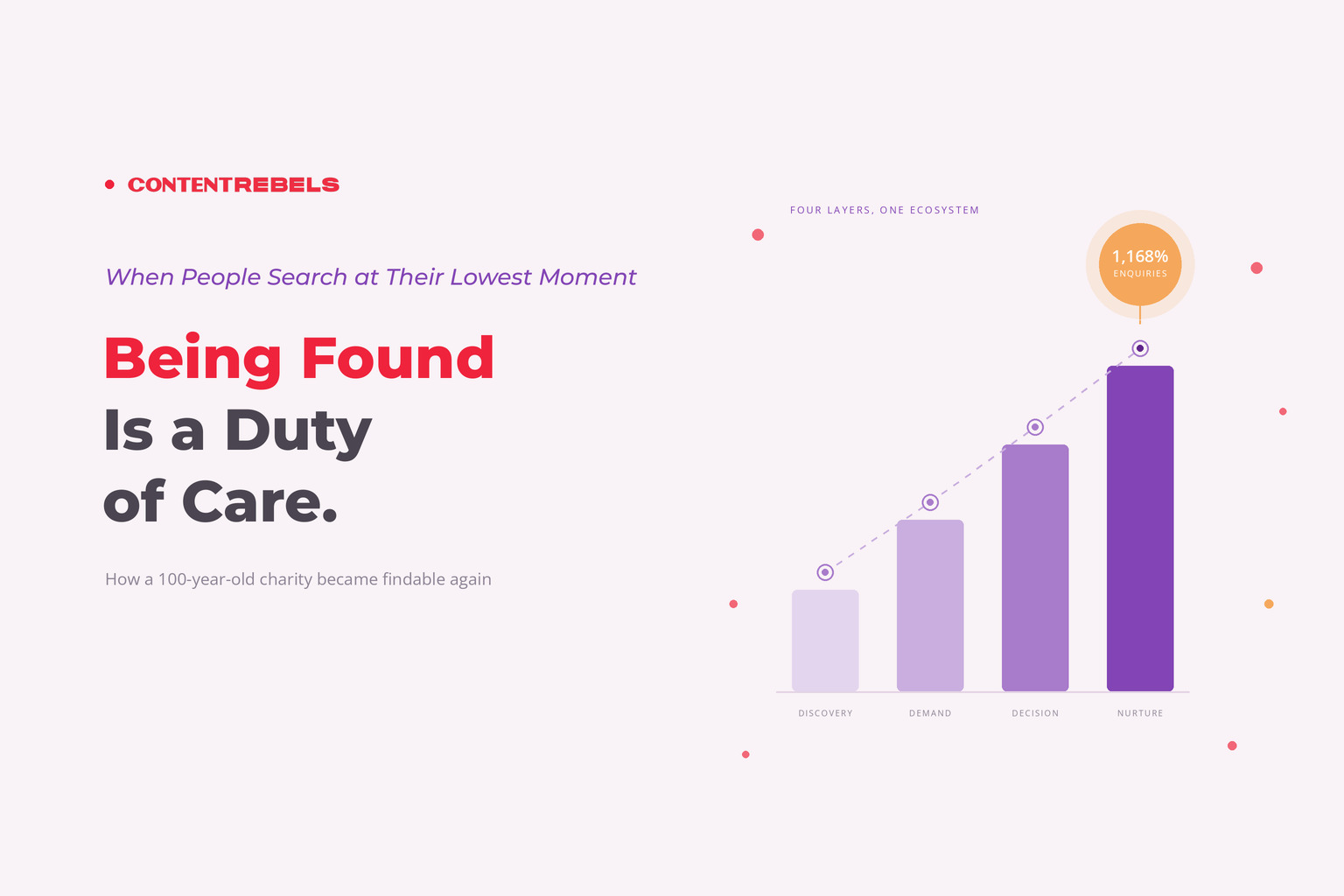
Four layers, each feeding the next
We organised 12 months of work into four connected layers. Why four instead of one big push? Because each layer hands the next a warmer visitor.
- Layer 1: Discovery. We used the centenary as a springboard, with a 100 Years landing page, long-form articles, and an Annual Report video featuring the CEO and Chair. We also provided blog articles and social media posts to amplify Cringe Quest, a free menstrual education game for 8- to 12-year-olds and the biggest evolution of Interrelate’s primary school education work in a decade.
- Layer 2: Demand generation. We turned fan-out data into 28 priority articles, each anchored to specific Ownables (semantic entities) and informed by 28 expert interviews.
- Layer 3: Active decision. We rebuilt the psychology service into a real conversion engine.
- Layer 4: Nurture and retention. We added email workflows that pull past clients back into wellness check-ins.
Four layers. One ecosystem. Every asset tied to a measurement point that didn’t exist before we came on board.
What a year of Search-First delivered
Did it work? The year-on-year numbers are hard to argue with. So, what actually changed?
- Organic sessions grew 1,059% to 10,824.
- New users grew 1,048%.
- Returning users grew 1,151%.
Numbers that size don’t come from a few clever blog posts. They come from a not-for-profit SEO system built to compound.
But sessions are only the doorway. What matters is who walked through it and reached out. So we measured the whole way from first impression to booked appointment, not just the traffic figure most reports stop at. This is where a connected ecosystem earns its keep: every layer was built to hand the next one a warmer, better-qualified visitor. Traffic that doesn’t convert is just noise with good PR. So we held ourselves to the harder number… the one that means a real person got real help.
From a search to a real conversation
Here’s the number that actually matters. Enquiry-intent conversions grew 1,168%, to 596. That’s 596 Australians who moved from a Google search to a form submission or a phone call to Interrelate! Click-to-calls alone jumped 1,628%!
Sit with what that represents. Nearly 600 people who, a year earlier, might have searched and only found Interrelate’s competitors. The site now converts enquiry intent at 5.5% overall, with the Caringbah Family Relationship Centre page at 14.1% and the mental health support page at 6.73%.
Both sit well above typical not-for-profit benchmarks. And delivered organically, those 596 conversions are worth an estimated $30,000 to $60,000 in Google Ads that Interrelate never had to spend. For an organisation counting every dollar, that’s money that goes straight back into frontline services instead.
Cited by AI from month one
The search-focused articles were only weeks into the index when the early signals landed. And they were clear. Within the first month, six of six tracked articles surfaced as Google AI Overviews for their target queries. Fast, for content that new.
The keyword movement shows exactly how fast. ’Does marriage counselling help’ went from position 17 to 1. ’Couple counselling fees’ from 10 to 1. ’Child focused mediation’ from 3 to 1. So when someone now asks Google or an AI assistant about counselling, mediation or mental health support, Interrelate increasingly shows up. That’s the kind of AI search visibility most organisations in the sector simply don’t have yet. And in a category where trust is everything, being the cited source is worth more than a page of ads ever could be.
The reach a paid budget usually buys
A Search-First Content Ecosystem doesn’t stop at the search bar. The centenary films, a client story and the leadership video were all built to travel. And they did. On LinkedIn, engagement climbed to 10.3% against a 2% brand-page benchmark. On Facebook, views from people who don’t even follow Interrelate grew 518%, real cold-audience reach at scale. On Instagram, a near-zero base turned into thousands of views a month, up nearly 4,000%.
That’s paid-tier behaviour on organic spend, and for an NFP watching every dollar, it’s not a vanity number. It’s more people carrying Interrelate’s message into rooms the organisation couldn’t buy its way into. Every share, every save, every forward is another Australian who now knows where to turn when someone they love needs help.
The stories the numbers can’t hold
Not every win shows up in a graph. Some of the most important work was simply human.
We produced a short documentary-style film with Charlotte Rose, a young domestic violence survivor who trusted us to help tell her story. It screened at the 2025 AGM, sits in the Annual Report and lives on the website. Ian Wells, Interrelate’s Senior Manager, Marketing, Business Development, called it ‘one of the most touching pieces of video this organisation has ever been able to deliver’. Handled with the care a story like that demands, it did what good content should. It helped people feel less alone.
Then there was the advocacy. When future NSW Government funding for Family Relationship Services Australia became uncertain, we turned a rapid-response brief around in two days, with a long-form article and social assets making the case. A small turnaround that helped inform funding decisions for the whole sector.
What your not-for-profit can take from this
We’re sharing this because the pattern behind it holds for most not-for-profit organisations, not just Interrelate. You don’t need a century of history or a big budget to use this playbook. You need to work in the right order, because order is what makes a small not-for-profit SEO budget go further. So where should a lean team actually start?
Measure from first impression through to real enquiry, so you can prove social return to the funders and boards who need to see it.
Fix the journey from search result to enquiry first, so the visibility you earn later has somewhere to convert.
Map how your audience really searches before you write anything, because the words they use are rarely the words your organisation uses internally.
Write for the person in the moment, not the algorithm, especially when your subject matter is sensitive or high-stakes.
Anchor your content to a few Ownables you can credibly hold, rather than chasing every keyword in the sector.
How we build Search-First Growth partnerships that compound
So was this a one-off campaign that fades once the centenary passes? No. It was a system, built to keep working long after the anniversary year ends. That’s the difference between a content vendor and an embedded partner.
We run this as a Search-First Strategy, powered by a human-led AI Content Engine, that lets a lean team produce serious depth without losing tone or accuracy on subject matter this delicate. The 28 articles, the rebuilt psychology service and the video set are working assets now, not spend that stops. That’s how you design, build and scale a search position that holds.
How Content Rebels turns Audit into Strategy
Content Rebels turns the audit into a Search-First Strategy by connecting visibility findings to Ownables, content systems and reporting.
Our Free Search-First Audit looks at Traditional search signals, AI Search visibility, competitor presence and content readiness. Then we show the first moves your team can make with the skills and tools already in the business.
The audit can also point to an AI Content Engine when the gap is production consistency. It can point to Digital PR when the gap is authority. Or reporting when leadership cannot see progress. We design, build and scale the response with documentation and training so your team grows stronger through the process. That matters because this work should build internal capability, not create permanent agency dependency.
Content Rebels took the time to intimately know our business, brand nuances, stories, and history to shape ownable content moments… A century in, Interrelate is the most digitally findable it’s ever been.
— Ian Wells, Senior Manager, Marketing & Business Development, Interrelate
Want to see what this kind of partnership could look like for your cause?
This work led us to become finalists in the 2026 Australian Marketing Institute Marketing Excellence Awards, Not-for-Profit Marketing category, and it’s the kind of partnership we’ve built for every not-for-profit client we’ve had the pleasure of working with – The Bread & Butter Project, Prince of Wales Hospital Foundation and Top Blokes Foundation, just to name a few. If your organisation does work that matters and still gets outranked by better-funded competitors, you’ve got the same not-for-profit SEO gap Interrelate had.
If that sounds like your organisation, the fix isn’t more content for its own sake. It’s the right content, built on a foundation that converts, mapped to how your people actually search. Why stay invisible to the very people you exist to help?
BOOK YOUR SEARCH-FIRST GROWTH STRATEGY AUDIT
Or, download our Search-First Strategy Playbook to see where a Search-First approach could take your organisation.
The not-for-profits who build their search landscape now will be the ones people find first for the next decade.

Founder of Content Rebels | Proud marketing and strategy nerd