Why a content strategy for AI Search needs an Engine
You’ve run the audit.
Now the awkward part arrives. Your brand is missing from prompts it should own, a competitor is getting cited and one AI answer is using language that looks like it escaped from 2019.
What content strategy for AI Search needs
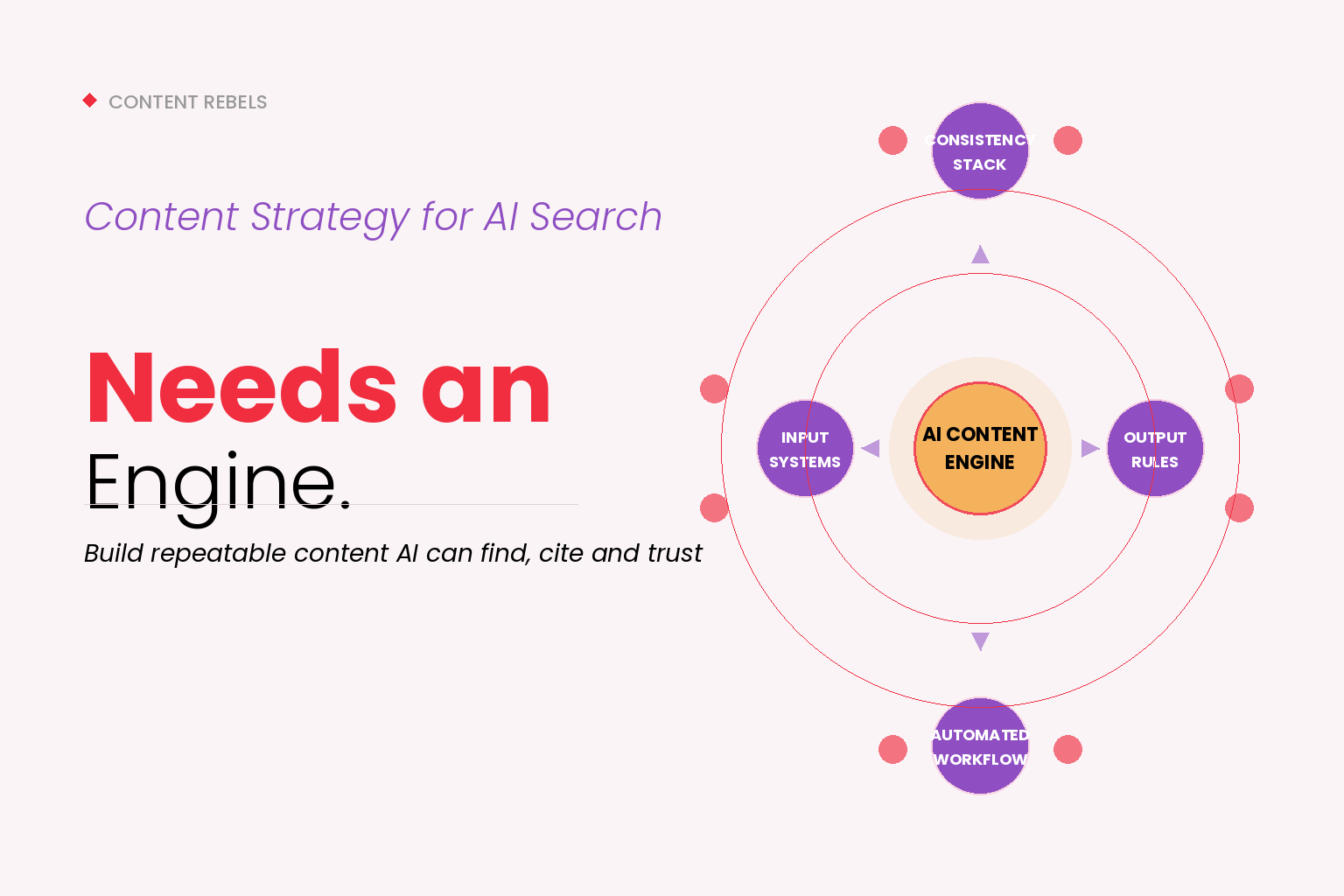
A content strategy for AI Search needs a system that turns visibility gaps into repeatable content decisions. The answer is not a prompt library. It’s an AI Content Engine: a working setup that combines a Consistency Stack, Content Output Rules, Content Input Systems and Automated Workflow Integration.
The Engine helps your team create content that is Discoverable, Retrievable and Citable across ChatGPT, Claude, Gemini, Perplexity and Google AI Mode. It also protects the brand from AI slop, which is what happens when production gets faster but the strategy gets thinner. Faster wrong is still wrong. Annoying, but true. Which Ownable should the page support? Which proof should it carry? Which answer should AI be able to quote? No guessing.
The post-audit moment is the real test
The post-audit moment is where many teams wobble. They have the gaps, screenshots and competitor examples. Then the content plan starts drifting back to old habits. More blogs. More FAQs. More “thought leadership” with the nutritional value of damp cardboard.
A Search-First team does something different. It chooses the Ownables that matter, then builds the content rules, inputs and workflow needed to repeat them properly. This is how an AI search content strategy becomes operational.
- Which gap matters commercially?
- Which answer needs fixing first?
The audit gives the team a starting order, not a pile of interesting screenshots. The team moves from “we need to appear in AI answers” to “we need this claim, this proof and this format to close this gap”.
Why prompt libraries fail quickly
Prompt libraries fail because they treat content like a one-off output. They usually hold instructions, not strategy. They do not define Ownables, carry proof, control brand language, map content to Share-of-AI-Voice or connect each asset to a visibility gap.
A prompt can help a writer start. It cannot replace the system that decides what the content should prove. What should this piece prove? Which source backs it? Where should it send the reader next? Those decisions come before the draft. Semrush reports the average AI Search visitor can be 4.4 times as valuable as a traditional organic search visitor by conversion rate. Translation: the citation gap may be small in traffic today, but commercially useful when the right buyer arrives.
Generic output weakens Ownables
Generic output weakens Ownables because it makes every brand sound interchangeable. If your category definition, comparison page, case study intro and executive post all use different language for the same claim, AI systems get a messy signal and humans get a boring one. That is not a vibe we recommend.
Search data may call this and AI Search Optimization content strategy or SEO strategies for AI Search, but the actual work is clearer: repeat the right ideas with enough proof and structure that they become easy to retrieve. Without that discipline, the team simply produces more material for the machine to ignore. What do we call this idea? Where have we proved it? Repetition with evidence is the part that compounds
How the AI Content Engine works
The AI Content Engine works by joining strategy, brand consistency and production workflow. It gives your team a repeatable way to create Search-First content without starting every asset from a blank page or a vague prompt.
Recent arXiv research on citation absorption found high-influence pages tend to be structured, semantically matched and rich in extractable evidence such as definitions, numerical facts, comparisons and procedural steps. Translation: AI Search does not reward vague content that hides the useful bit. The Engine makes the useful bit easier to find, repeat and support. It also stops every content brief from becoming a custom rescue mission. Same spine, different asset, fewer rescue emails. Beautifully boring. Useful too. And repeatable.
Consistency Stack
The Consistency Stack is the source of truth for how the brand sounds, what it claims and what it refuses to publish. It holds:
- voice rules
- approved phrases
- proof points
- banned patterns
- the Ownables the brand is building.
For AI Search, this matters because consistency strengthens entity clarity. If the website says one thing, the sales deck says another and the PR quote uses a third version, the system has to guess. Humans do too.
The Consistency Stack reduces that friction. It gives the team one shared source for language and proof, which is deeply unglamorous and wildly useful. This is the quiet infrastructure behind content buyers can trust and AI systems can retrieve without guessing
Content Output Rules
Content Output Rules define what each asset type must include. A blog article, case study, service page, LinkedIn post, comparison page and nurture email should not follow the same structure. Same strategy. Different job.
For AI Search, output rules help make content easier to parse, turning structure into visibility. This typically includes:
- Direct answers under headings so AI systems can extract clear responses quickly
- Proof placed close to claims to strengthen attribution and trust signals
- Tables for comparisons where differences need to be scanned and interpreted easily
- Clear definitions for terms and concepts the buyer needs to understand quickly
Search Engine Land has described AI discovery as depending on retrievable structure, taxonomy, schema and content chunking. Translation: structure is not decoration. It’s part of the visibility system. Output rules also make review faster because the team can check against agreed standards instead of taste, panic or the loudest stakeholder in the room.
Content Input Systems
Content Input Systems decide what raw material the team and AI tools can use. This is where effective strategies to optimize content for AI-driven search results become less magical and more procedural. Give the system:
- audience pain points
- audit findings
- subject matter input
- approved proof
- competitor notes
- source links
- product details
- the Ownables each asset should support.
Better inputs make better drafts. Weak inputs make the internet smoothie nobody ordered.
The Engine should make strong inputs normal, not heroic. That is how the team keeps quality high without turning every brief into a tiny Olympics. It also gives AI the context it needs to help, rather than inviting it to invent authority from thin air. No mystery sauce. Better briefs.
Automated Workflow Integration
Automated Workflow Integration connects the Engine to the way content actually moves through the business.
Briefing, drafting, review, legal, subject matter checks, SEO checks, AI Search checks, publishing, updates and reporting all need a path. The goal is not to remove humans. The goal is to stop burning human judgement on repeatable admin.
Your marketers still need point of view, category knowledge and commercial sense. The workflow gives them more room to use those skills. It also makes the Engine easier to improve every 90 days because the review points are built into the process. That review rhythm matters when AI Search surfaces shift and yesterday’s neat answer starts to wobble.
What should your team build first?
The temptation is to fix every asset, channel and workflow at once. Do not.
Build the smallest useful Engine first. Start with one Ownable from the audit, one priority buyer question and one content format that can close a visible gap. Then connect the Consistency Stack, Output Rules, Input Systems and Workflow Integration around that first use case.
Make it work.
Then repeat.
This is how the Engine starts compounding without overwhelming the team. It’s also how senior marketers protect time, energy and effort from production work that looks impressive and changes very little. Where is the gap? Which asset can close it? Who needs to approve it? Start there. Make the first lap easy, then repeat the pattern.
Five actions for this week
- Choose one Ownable from the audit that connects to commercial search demand.
- Write the approved definition, proof points and banned language for that Ownable.
- Build one output rule for the first content format your team will produce.
- Create an input pack with sources, customer language, competitor notes and expert context.
- Map the approval workflow from brief to publish so quality does not rely on memory.
These are deliberately small moves. Good. A content strategy for AI search should be easy enough for the team to keep using after the first burst of enthusiasm disappears. The aim is not theatre. The aim is a working system that can ship, check and improve the same idea across multiple assets without losing the thread.
How Content Rebels scales Search-First content
Content Rebels builds AI Content Engines for teams that need Search-First content at scale without shipping slop. This is an what AI Search strategy means for Search-First teams. We start with the audit, define the Ownables, build the Consistency Stack and then create the rules, inputs and workflow that let the team produce better content faster.
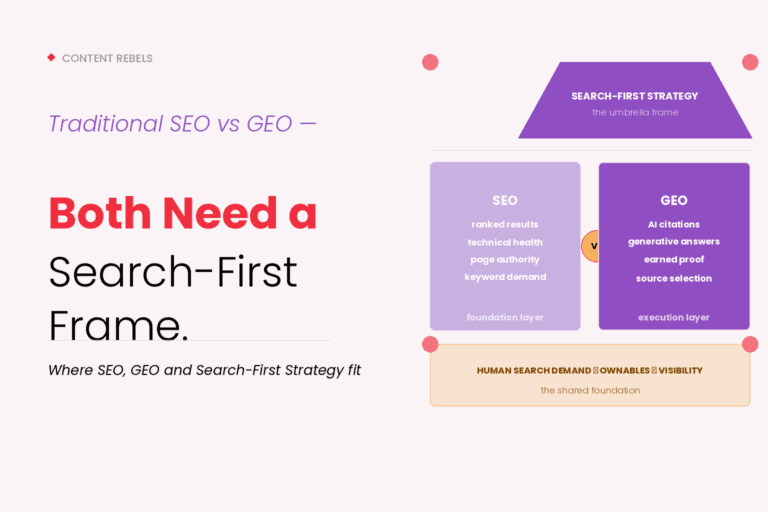
This is connected to Search-First Strategy, not separate from it. The Engine is the production layer. The strategy is the spine. Both need to work together if the brand wants to stay visible across Google and AI Search.
We also train the team on the system, because a useful Engine should build internal capability rather than create another dependency nobody can explain. Properly.
Proof keeps the Engine commercial
The Engine only matters if it supports measurable visibility and demand. Content Rebels usedthe same Search-First Growth Framework across different content systems, including Healthylife’s 157 percent Search revenue lift and Affinda’s 87 percent AI Search traffic lift.
Translation: the system should connect content quality to commercial signals, not just publishing volume.
We also document the Engine so the in-house team can keep using it. Capability transfer matters. Nobody needs a magic content machine that only the agency knows how to operate. The better outcome is boringly practical: your team knows the Ownables, understands the rules and can brief the next asset without starting from scratch.
The goal is visibility buyers can trust
Knowing how to build an AI Search optimisation strategy means making. the brand easier to find, understand and cite.
That means fewer random assets and more connected proof.
It means fewer vague prompts and more useful inputs.
It means fewer brand-language contradictions and more Ownables repeated with discipline.
The work can feel less dramatic than chasing a new platform trick. Good. Calm systems tend to beat noisy experiments when the goal is long-term visibility.
The point is not to publish more because AI exists. The point is to build content that buyers and machines can trust for the same reason: It’s clear, specific and supported. That is calm in the chaos, not another rush at a shiny tactic because a platform changed its label.
Need the quiz or the audit first?
Take the How Much Is Content Production Really Costing You? quiz if your team needs to see where production drag is costing time and quality. Book the Free Search-First Audit if the bigger issue is AI Search visibility and you need the diagnostic first.
Start with the quiz when production pain is obvious. Start with the audit when citation gaps, competitor mentions or leadership pressure are already in the room. Either way, the next step should give your team a system it can own.

Founder of Content Rebels | Proud marketing and strategy nerd