The way humans search has changed. Most marketing strategies haven’t
The conversation about search right now is fixated on platforms. Google is changing. AI tools are evolving. New features appear almost weekly, each one adding to the sense that marketers are somehow falling behind.
That noise is understandable. Organic traffic that once felt relatively stable is becoming less predictable. Google’s AI Overviews and AI Mode are changing how information is surfaced in traditional search. At the same time, tools like ChatGPT, Claude, Perplexity and Grok are becoming everyday search interfaces for more and more people. Meanwhile, platforms like TikTok, YouTube, Reddit and even Instagram increasingly shape how people discover information, compare options and build trust.
Inside organisations, this has created pressure. Leadership teams are asking what it all means. Marketing teams are being told to respond. The result is often a scramble for tactics, terminology and quick fixes.
But the more important shift isn’t technological – it’s behavioural. The way people search has changed. And this isn’t just a search conversation… it’s a revenue conversation.
People are now asking more layered questions, moving across more platforms, expecting more direct answers and taking less linear paths toward decisions. Yet many marketing strategies are still built for a much simpler version of search.
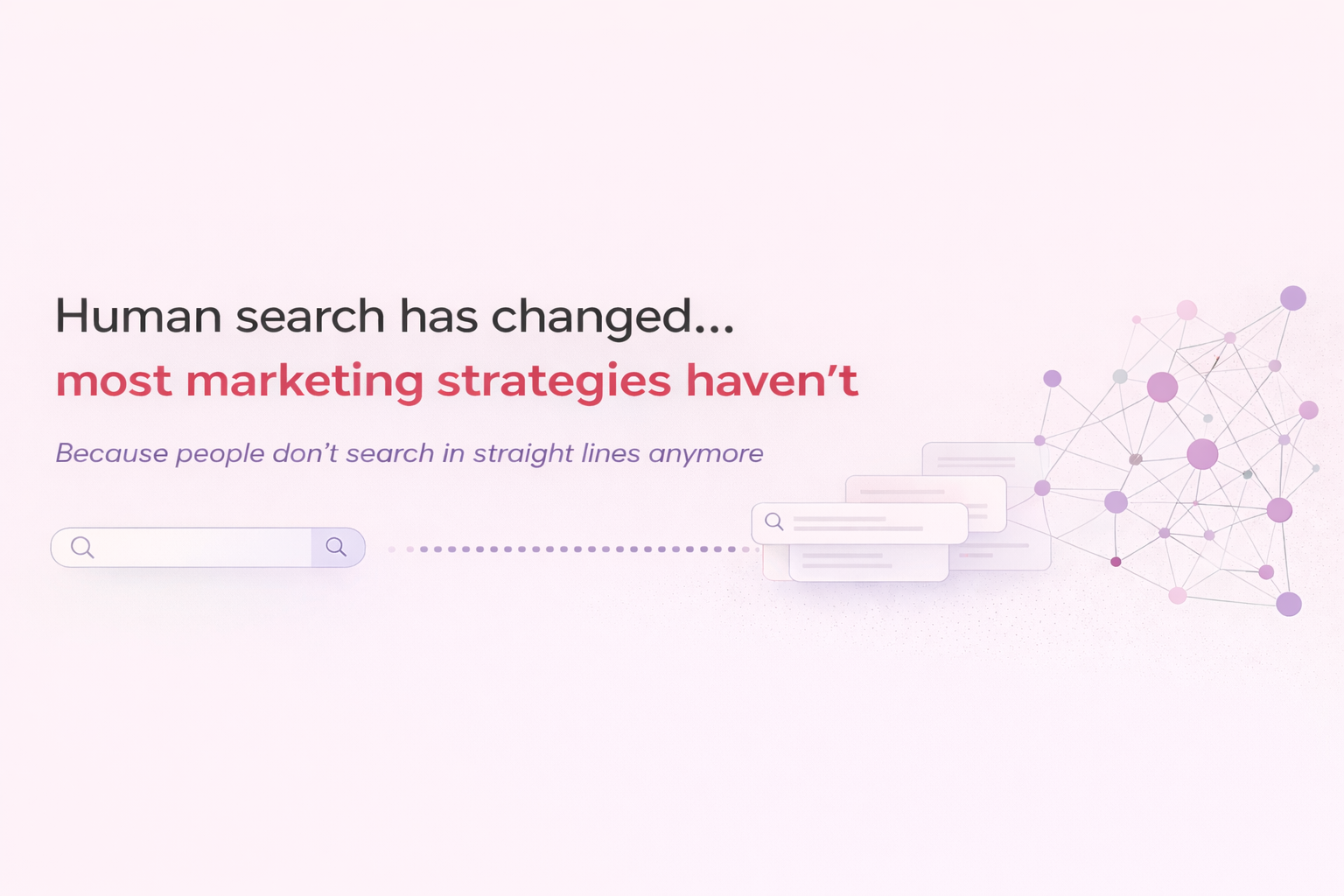
That is the real mismatch. Human search has changed. Most marketing strategies haven’t.
Why this matters now
For years, many marketing teams operated with a relatively clear search playbook. You identified keywords, built content around those keywords, improved technical foundations, earned backlinks and tracked rankings and traffic. It was never as tidy as the theory suggested, but the overall model was familiar enough to feel stable.
Today, that stability is much harder to rely on.
Search behaviour is fragmenting across platforms. AI-generated answers are changing how people access information. Some searches are resolved before a click ever happens. At the same time, audiences are using a broader mix of channels to investigate, compare, validate and decide.
For in-house marketers, that creates a strategic problem. This is where many teams start to feel the cracks… even if they can’t yet explain them internally.
The old model isn’t broken, but it IS holding teams back. Teams can feel this in practice before they can always explain it clearly. Organic performance becomes harder to interpret. Content demand increases, but priorities feel less obvious. Leadership wants answers, yet the industry conversation around search is full of extremes.
Some voices claim everything has changed. Others insist nothing has. Neither position is especially useful when you’re trying to make smart decisions inside a real organisation.
What matters now isn’t choosing a side in the latest search debate. It’s understanding what has actually shifted beneath the surface.
The real shift is behavioural
It’s tempting to treat the current moment as a technology story. In some ways, of course, it is. But the deeper shift is behavioural.
Over time, the way people search has evolved from simple lookup behaviour into a more complex process of exploration, validation and decision-making. Search began as a relatively finite act. We typed in a word or two. We scanned the results. We clicked through to a source. We did the work of piecing together the answer for ourselves.
Then those words became keywords and questions. Search became more natural, more precise and more intent-driven. Voice search nudged people further toward conversational language. Social platforms trained audiences to seek recommendations and lived experiences alongside formal information. AI tools then accelerated another step forward by teaching people to ask layered, contextual, multi-part questions and expect a synthesised answer in return.
What used to be a query is now often a journey.
Someone researching a category might start with Google, skim a few results, ask ChatGPT to summarise the differences between options, check TikTok for social proof, watch a YouTube video for a visual explanation, read a Reddit thread for honest opinions, then return to search with a much more specific question.
That behaviour is no longer unusual. It’s the norm.
Once you look at search this way, the current marketing confusion starts to make sense. The problem isn’t just that Google is changing or AI tools are rising. The problem is that many brands are still planning around an older, narrower model of how people discover and evaluate information.
People now search across a journey, not just a channel
One of the biggest strategic implications of this shift is that search can no longer be understood as a single-channel activity.
People don’t think in neat platform categories. They don’t pause and decide, “Now I’m doing traditional search”, followed by, “Now I’m doing AI search”. They’re simply trying to understand something, solve something, compare something or choose something. They move toward the answer in whatever way feels fastest, easiest or most trustworthy.
That means search is increasingly:
- conversational rather than purely keyword-based
- exploratory rather than purely transactional
- iterative rather than one-off
- fragmented rather than contained
- context-rich rather than minimal
It also means expectations have changed.
People expect better answers, faster. They expect platforms to do more of the synthesis. They expect information to be personalised, relevant and easy to act on. AI search has accelerated those expectations, but it didn’t invent them.
This matters because most marketing strategies are still designed around a narrower set of assumptions. They assume people will discover information in predictable places. They assume one piece of content can do one job in one moment. And they assume that if you rank for the right keyword, the rest of the journey will take care of itself.
That’s not really how search works anymore.
Where most marketing strategies are lagging behind
Many current strategies still reflect a world where search was more linear and more contained.
They tend to focus on:
- ranking pages rather than building topic authority
- channels in isolation rather than connected discovery journeys
- short-term traffic gains rather than long-term visibility
- publishing volume rather than content ecosystems
- campaign priorities rather than audience search behaviour
Again, none of those things is inherently useless. Technical SEO still matters, rankings and traffic still matter. The issue is that, on their own, they’re no longer enough to guide strategy.
This is where many teams get stuck. They can see that something feels different, but their strategy still pushes them toward older patterns. More blog posts. More keywords. More optimisation. More activity. More effort… without stronger outcomes.
What often gets lost is the only question that really matters: How is our audience actually searching now and what does that mean for how our brand needs to show up?
Without that question at the centre, activity expands, but authority doesn’t. Content grows, but cohesion doesn’t. Teams keep moving, but the strategy underneath them becomes less and less aligned with how people really search.
This is why channel-first thinking is becoming less useful
When search was more contained, channel-based planning made more sense. SEO sat over here. Social sat over there. PR did its own thing. Paid media had its own goals. Content supported all of them, often in different ways for different teams.
The problem is that search behaviour no longer respects those boundaries.
A person can discover a brand in one place, validate it in another, compare it in a third and convert after returning through a fourth. Visibility is no longer built in neat silos. It compounds through repeated exposure, relevance and trust across a broader ecosystem.
That’s why channel-first thinking is no longer a reliable starting point for strategy.
It encourages fragmentation. Different teams create different kinds of content for different channels with no shared centre of gravity. Authority gets diluted rather than reinforced. Content themes multiply without building toward a meaningful position.
The alternative isn’t to stop caring about channels. It’s to stop treating them as the starting point. The starting point should be search behaviour itself.
What this means for strategy
If the way people search has changed, strategy has to change with it. That doesn’t mean abandoning the useful parts of existing search, content or brand strategy. It means widening the frame.
A more useful strategic response starts by asking:
- what is our audience actually searching for?
- how are they searching?
- what stages do they move through before they are ready to choose?
- what questions, comparisons and adjacent concerns surround those searches?
- where are they building trust?
- what topics do we want our brand to become known for within that landscape?
Those aren’t just SEO questions. They’re strategic questions. Once you answer them, content becomes easier to prioritise, distribution becomes easier to connect, and authority becomes easier to build intentionally rather than accidentally.
This is where Search-First Strategy becomes not just useful, but necessary.
Search-First Strategy is the response to the human search shift
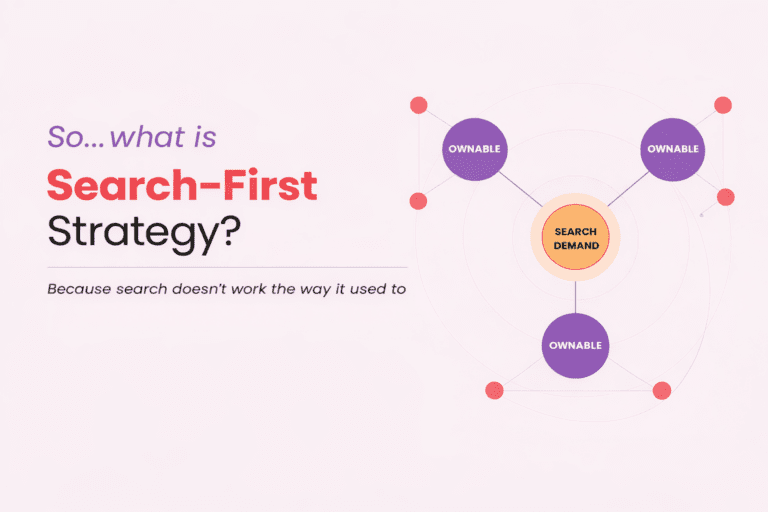
Search-First Strategy begins with human search demand and uses that demand to shape what a brand creates, publishes and distributes.
Instead of starting with what the brand wants to say, it starts with what people are already searching for, asking, comparing and trying to understand. From there, it identifies the topic spaces a brand can credibly own. Those spaces then become the basis for content ecosystems that help the brand become discoverable, retrievable and citable across traditional, AI and social search.
This is an important distinction.
Search-First Strategy isn’t about chasing every new platform. It’s not about building disconnected strategies for Google, AI, TikTok, YouTube or Reddit. It is about creating a more useful strategic frame for all of them by understanding the underlying behaviour that connects them.
That’s what makes it more durable than a reactive channel plan. It responds to how people search, not just to whatever platform is making the most noise this month.
Why this has real commercial implications
This isn’t just a theoretical shift. It has real commercial consequences.
When a brand understands how its audience now searches, it can start showing up much earlier and more effectively across the decision journey. It can become visible not just when someone is ready to buy, but when they are still trying to understand a problem, explore a category or compare options.
That kind of visibility matters. It means a brand is more likely to:
- shape how a category is understood
- be associated with the right topics
- earn trust before the shortlist is final
- generate stronger quality traffic
- improve conversion efficiency over time
By contrast, brands that remain overly focused on the narrowest end of the journey often end up fighting in the most competitive and expensive part of the market.
They’re trying to convert demand rather than shape it.
This is one of the reasons the current shift feels commercially significant. It’s not just that search is getting more complex. It’s that authority now plays a bigger role in how brands become visible across that complexity.
What better strategy looks like in practice
In practice, responding to this shift rarely means throwing out everything a team has already built. More often, it means clarifying what is already there and organising it more strategically.
A brand might regroup content around clearer topic territories instead of publishing broadly across too many disconnected themes. It might strengthen one meaningful authority space rather than chasing every possible content opportunity. It might connect educational content more deliberately to commercial pages. It might use recognised internal experts more intentionally to deepen credibility. It might finally bring SEO, content, PR and distribution into a more coherent ecosystem.
In other words, the biggest change isn’t volume. It’s clarity.
That clarity helps teams stop reacting to every market shift and start making better decisions about focus, investment and visibility.
The practical takeaway
Search will keep changing. New tools will appear. Existing platforms will evolve. Terminology will continue to evolve. None of that is likely to slow down.
But the most useful response isn’t to chase every development in isolation. It’s to understand the behavioural shift beneath them and build a strategy that is broad enough to respond to it.
The way people search has changed, and strategy needs to reflect that reality, not an outdated model of it. They ask more layered questions, expect more direct answers and build trust across a wider mix of environments. Many marketing strategies, however, are still built around a narrower and older model of how discovery works.
That’s the real gap.
A Search-First Strategy helps close it. It gives teams a clearer way to understand evolving search behaviour, identify the topic spaces their brand should genuinely own, and build connected authority around those spaces over time.
For many in-house marketing teams, that clarity is the difference between constantly reacting to change and navigating it with confidence.
If you’re working through those questions inside your organisation now, a Search-First Strategy session can help you step back, see the landscape more clearly and identify where your brand should focus next.
Sometimes, the most valuable outcome isn’t a long list of tactics. It’s leaving the conversation with a much clearer picture of what actually matters.
Book a Search-First Strategy Mapping Session with Sarah.

Founder of Content Rebels | Proud marketing and strategy nerd