Why you don’t need an AI Search strategy
“What’s our AI search strategy?”
This is a question many in-house marketers are being asked right now, often without a clear answer behind it.
Google is reshaping traditional search with AI Overviews and AI Mode. ChatGPT, Claude, Perplexity and other large language models are becoming everyday tools for research and recommendation. Vendors are pushing new terminology. LinkedIn is full of confident opinions. Inside organisations, the pressure to do something about AI is growing quickly.
In that environment, it makes perfect sense that brands assume they need a separate strategy for AI search.
An AI search strategy.
A GEO strategy.
A ChatGPT strategy.
But for most brands, this is the wrong approach. Not because AI search doesn’t matter. It clearly does. Not because visibility in AI-generated answers is irrelevant. It isn’t. And not because marketers should ignore what’s happening. They absolutely shouldn’t.
The problem is that a separate AI search strategy often treats the symptom, not the cause.
What’s changing is not just that a new interface has appeared. What’s changing is the way people search, the way platforms surface information and the way visibility is built across the full discovery journey. If you respond to that by creating a disconnected AI workstream, you often end up with more fragmentation, more duplicated effort and less strategic clarity.
You probably don’t need an AI search strategy. What you need is a BETTER search strategy.
Why everyone is asking this question
The instinct to create a dedicated AI search strategy is understandable.
AI search is visible. People are hearing about brands being cited in ChatGPT, surfaced in Perplexity or summarised in Google AI Overviews. That visibility feels new – and therefore urgent.
There’s also a strong commercial reason the question keeps coming up. Organic search performance has become harder to interpret. Zero-click behaviour is rising in some areas. Traditional search still matters, but the path from query to click no longer feels as straightforward as it once did. At the same time, leadership teams are reading the same articles, hearing the same buzzwords and asking the same anxious questions marketers are hearing everywhere else.
Should we be showing up in AI search?
How do we optimise for ChatGPT?
Are we behind?
What’s our plan?
That pressure creates a strong temptation to build something new and visible. A new document. A new workstream. A new strategy.
Something the team can point to and say, “We’re on it.”
The challenge is that this can create the illusion of progress without actually solving the strategic problem underneath it.
Why the instinct makes sense – and where it goes wrong
Most marketers aren’t wrong to feel urgency here.
Search is changing, visibility is shifting, AI search experiences are influencing how people discover, compare and decide. Ignoring that would be naïve.
Where the instinct starts to go wrong is in the framing.
Treating AI search as a separate strategic discipline assumes that the real issue is platform-specific. It suggests the task is to optimise for each new environment in isolation, as though your audience moves neatly between traditional search and AI search as separate behaviours.
That’s not how real people behave.
They might start with Google, ask ChatGPT to summarise what they find, watch a YouTube video, scan a Reddit thread, revisit Google with a more specific question, and then compare vendors on brand sites.
In that journey, they’re not separating channels in the way marketing teams often do. They’re just trying to figure something out.
That’s why a siloed AI strategy so often becomes the wrong organisational response. It takes a blended human behaviour and tries to solve it as a separate platform problem.
The search environments are blending, not separating
One reason the separate-AI-strategy idea feels logical is that the industry keeps speaking as though traditional search and AI search are entirely distinct categories.
In reality, they’re increasingly blending.
Google itself is the clearest example. AI Overviews and AI Mode aren’t external competitor channels. They’re AI search experiences embedded inside traditional search behaviour.
For the person typing in the query, that distinction often matters far less than marketers think. They’re still searching. The interface has simply changed.
Which means the strategic foundations are no longer separable.
If your content is weak, generic or disconnected, that weakness doesn’t just hurt you in traditional SEO. It also reduces your chances of being surfaced, cited or associated with the right topics in AI-driven environments. If your brand has no meaningful authority in a topic space, creating an AI strategy won’t magically fix that. If your content ecosystem is fragmented, AI visibility will likely be fragmented too.
The more useful way to think about this is not that AI search sits outside your strategy, but that it exposes the weaknesses within it.
That is a very different problem. And it requires a different answer.
The better question to ask
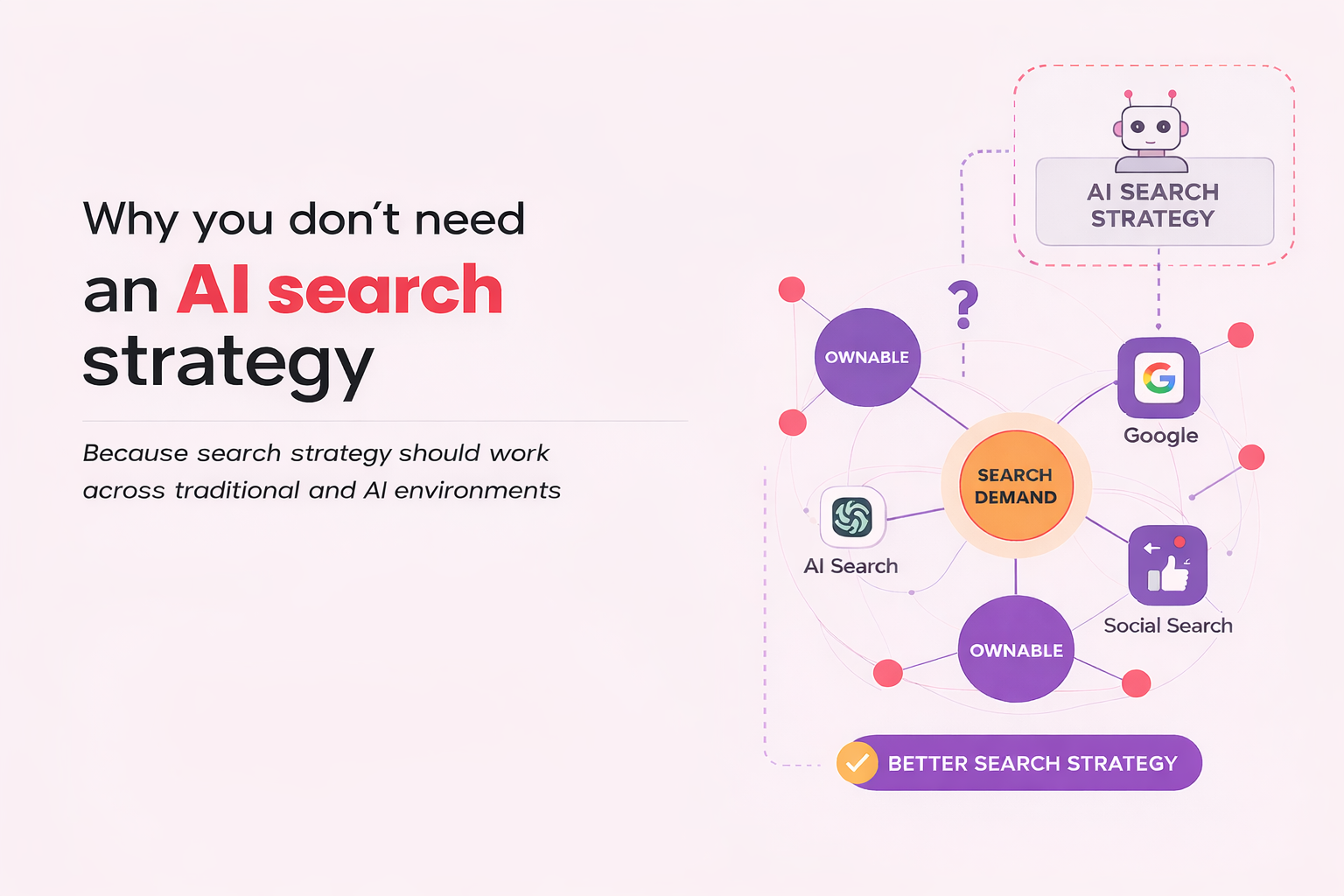
Instead of asking, “What is our AI search strategy?”, ask: “How do we evolve our search strategy to respond to the way people now search?”
That question immediately changes the conversation.
It shifts focus away from a single technology and towards a broader strategic issue. It moves the team away from reacting to a platform and toward understanding a behaviour. It also prevents the organisation from building disconnected workstreams that create more complexity than clarity.
This is the point at which Search-First Strategy becomes useful.
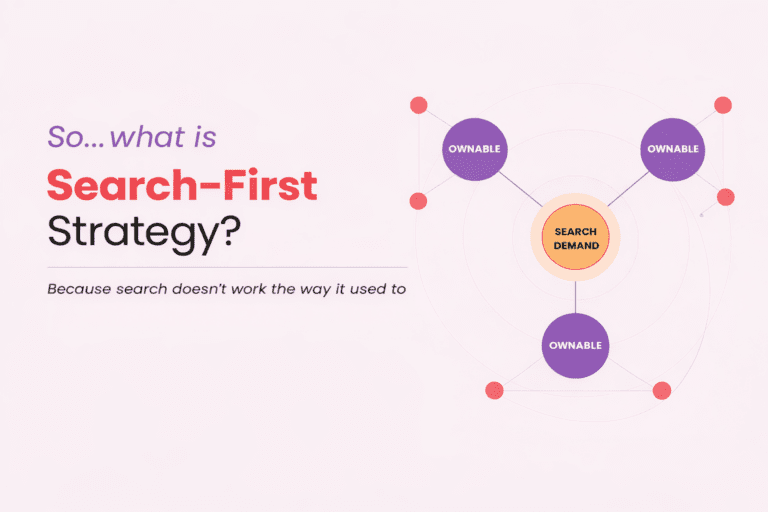
A Search-First Strategy starts from the premise that the real job isn’t to optimise for one new channel in isolation. It’s to understand how search behaviour is evolving, what your audience is actually looking for, where your brand has a right to lead, and how to build authority that carries across traditional search, AI search and other discovery environments.
That is a much more durable response than a standalone AI plan.
What Search-First Strategy does better
Search-First Strategy works better than a siloed AI strategy because it starts with the thing that actually matters most: human search demand.
It asks what your audience is searching for, how they search, what questions and comparisons appear around a topic, and where those needs show up across the decision journey. From there, it helps define the topic spaces your brand can genuinely own. We call those spaces ‘Ownables’. Once those Ownables are clear, content and distribution can be mapped around them across both owned and earned channels.
Because authority isn’t built through isolated assets – it compounds through consistency and coherence.
A Search-First Strategy helps you create:
- stronger topic authority
- clearer content priorities
- more connected ecosystems across channels
- better alignment between educational and commercial content
- more visibility in the places your audience now searches
It also reduces duplication. Instead of one team trying to ‘do AI’, another trying to ‘do SEO’, and another trying to ‘do content marketing’, the organisation can work from a more integrated frame.
That is especially useful for in-house teams, where complexity has a habit of multiplying quickly. The more disconnected strategic categories you introduce, the harder it becomes to prioritise, explain and execute. Search-First Strategy simplifies by widening the frame.
What still matters specifically for AI search
To be clear, saying you don’t need a separate AI search strategy isn’t the same as saying AI-specific work doesn’t matter. It does.
Teams still need to understand:
- how often and where their brand is appearing in AI-generated answers
- how prompts and personas influence visibility
- how discoverability and citation-readiness work
- how authority signals show up in AI search environments
- how to adapt reporting as visibility shifts
In other words, AI visibility still needs to be tracked… and it still deserves strategic attention. But that attention should sit inside a broader Search-First Strategy, not in a disconnected silo.
That’s the difference.
When teams treat AI search as part of the overall search ecosystem, they can:
- map prompts back to real search demand
- understand how content performs across surfaces
- connect visibility to topic authority
- avoid chasing isolated platform wins
That’s far more useful than producing a separate strategy document with ‘AI’ in the title and hoping it holds together.
Why a separate AI strategy often creates more problems than it solves
This matters because bad framing has operational consequences. When a team decides it needs a separate AI strategy, what often follows isn’t clarity. It’s fragmentation.
A new workstream appears. New tactics get added without clear prioritisation. Reporting gets split. Ownership becomes fuzzy. The same foundational issues get tackled in multiple places under different names.
That’s how complexity creeps in.
And complexity isn’t neutral inside an organisation. It creates confusion in teams, muddier decision-making, harder stakeholder conversations and more pressure on already stretched marketing functions.
By contrast, a Search-First Strategy creates a stronger internal frame.
It helps teams say identify:
- what has actually changed
- what still matters
- where they need to adapt
- how AI visibility fits into the wider picture
- what they will prioritise first
That’s a much better story to take to leadership.
What this means for in-house teams right now
For in-house marketers, this isn’t just a conceptual debate. It affects planning, reporting, prioritisation and team confidence.
A siloed AI strategy can feel like action, but in practice, it often becomes another layer of noise. It gives teams one more thing to explain, one more set of tactics to manage and one more category to force into an already crowded system.
A Search-First Strategy brings the opposite.
It gives teams:
- a clearer framework for stakeholder conversations
- a more coherent way to prioritise content
- a stronger link between search, brand and thought leadership
- a better way to explain why visibility matters beyond clicks
- a more realistic model for how audiences actually discover and decide
This is why a Search-First Strategy process can bring so much clarity. It helps teams to stop reacting… and start leading.
What this means for your search strategy
AI search matters. It is reshaping discovery. It is influencing visibility. It is changing how information is surfaced and how audiences build trust.
But that doesn’t automatically mean you need a separate AI search strategy.
In most cases, what you actually need is a broader, stronger and more current search strategy. One that reflects how people now search across traditional, AI and other discovery environments. One that starts with human search demand, identifies the topic spaces your brand should own, builds connected content ecosystems around those spaces and tracks visibility in a more realistic way.
That’s what Search-First Strategy is designed to do. It doesn’t ask teams to ignore AI. It asks them to place AI in the right strategic context. It turns a reactive platform question into a more useful business question.
Not: “What’s our AI strategy?” But: “How do we build a search strategy that actually matches the world our audience now searches in?”
That’s the better question. And for most brands, it leads to a much better answer. You don’t need another disconnected strategy layered on top of what already exists. You need a better one.
If your team is currently trying to work through what AI search means for your brand, a Search-First Strategy session can help bring structure, clarity and a much more useful path forward.
Book a Search-First Strategy Needs Assessment with Sarah.

Founder of Content Rebels | Proud marketing and strategy nerd