How speakers and individuals can win in AI Search
If you’re a professional speaker, the way event organisers and bookers find you has changed more in the last three years than it did in the previous twenty. And most of the advice still circulating about “building a speaker website” or “getting on social media” was written for a world that no longer exists.
I want to walk you through what’s actually happening, what the data says about how bookers behave now and the four things you can do to make sure your name keeps surfacing when it matters.
The old playbook has been quietly torn up
Before 2022, the rules of search were simple. A booker wanted a speaker, they’d asked a bureau contact or type a few words into Google before scrolling through a list of blue links. They then made a decision about which website to click. They read. They made another decision. They clicked again.
It was linear, it was a bit tedious and it was the game every speaker with a website was trying to win.
Then ChatGPT landed publicly and the game changed.
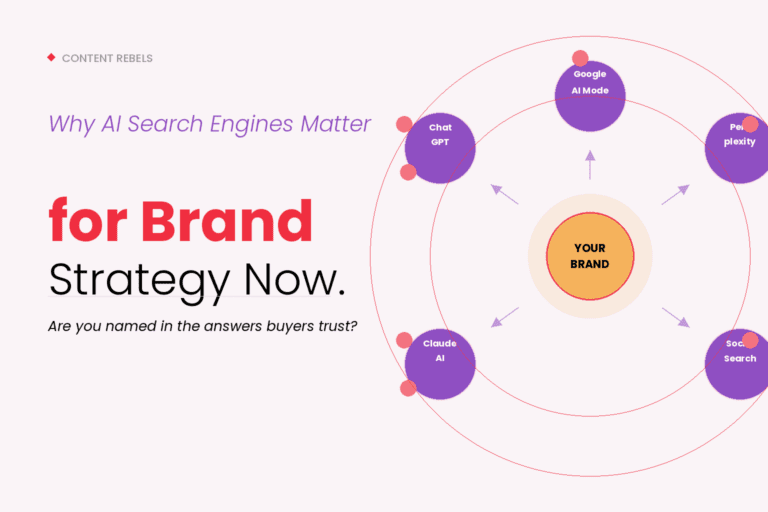
Now when someone wants to find a speaker, they’re just as likely to open ChatGPT, Gemini, Claude, Perplexity or Google’s AI Mode and type something like: “I’m organising a leadership offsite for 80 senior execs in Sydney in March. I need a speaker who can talk about navigating change without being cheesy. Who should I consider?”
And the platform answers. With a shortlist. With reasoning. With what sounds a lot like a recommendation from a trusted advisor.
The booker doesn’t need to click anything. They don’t need to visit your website. They don’t need to read your bio. The decision has effectively been made for them before they’ve even thought about picking up the phone.
According to Bain & Company, 60% of all global searches now end without a click. More than half the time someone searches, they’re getting their answer inside the search platform itself. The website that fed that answer? Never visited.
Why this matters ten times more for speakers
Just 18 months ago, Bigspeak surveyed event organisers on how they source speakers. The top answers were exactly what you’d expect: 67% through existing bureau relationships and personal recommendations, 52% through personal experience and 49% through search engines. Only 5% said they used AI tools to find speakers.
Fast forward to late 2025. PCMA surveyed AI usage among event companies and found 91% were using AI tools for event management, with 18% using them specifically for event planning and logistics – which includes speaker selection.
That’s the sharpest behavioural shift I’ve seen in fifteen years of doing this work. And it’s producing a knock-on effect that speakers bureaus are already quietly dealing with: bookers are now walking into conversations with AI-generated shortlists and asking, “Tell me about these five people.”
If you’re not on that list, you’re not in the conversation. Even if you’re the best person for the job.
The booker’s question has changed
Here’s the shift that sits at the heart of all of this.
Bookers used to search for you. Your name. Your bureau profile. A clip they remembered seeing.
Bookers now search for what they need solved – and the AI platform recommends the people to solve it.
Which means your job is no longer just to be findable by name. It’s to be visible for the topics you speak on, the industries you serve and the transformations you help drive. “Leadership speaker.” “Resilience keynote for healthcare.” “Innovation speaker for after-dinner events.” That’s where the game is being won now and it’s being won inside AI platforms that are synthesising information about you from across the open web.
What the AI bots can and can’t see
Before you can be visible in AI search, you need to know what these platforms are actually ingesting. The bots that crawl the web for every major AI platform can see:
- Your website – pages, blog posts, bio, images, video
- Publicly available media coverage – interviews, articles, profiles
- YouTube videos and podcast appearances, especially where transcripts are attached
- Any long-form thought leadership you’ve put somewhere with a public URL
What they can’t see – and this is where most speakers are leaking value:
- Your social media posts, even public ones. All the major platforms actively block scraping, so the gold you’re sharing on LinkedIn is largely invisible to AI search.
- Anything sitting in your email newsletter.
- Content in closed communities, Slack groups or private forums.
- Lead magnets and ebooks that live behind an email gate with no public URL.
The golden rule: if you can access it freely on the open web without logging in, so can the bots. If you can’t, they’re blind to it.
This is the part that usually makes speakers wince, because so much of their best thinking lives in exactly the places bots can’t reach. LinkedIn rants. Keynote clips shared only in the newsletter. The PDF gated behind an opt-in. None of it is feeding the AI’s understanding of who you are and what you stand for.
The mindset shift: search-first, not search-last
You don’t need to tear down your website and start again. You don’t need a full rebrand. What you need is a Search-First Mindset.
A Search-First Mindset means considering, with everything you publish, how it helps build your visibility for the bots – and therefore eventually your human audience. It starts with understanding exactly how bookers are searching for what you do, sell and solve. Which phrases do they use? Which are more in demand? Which are you realistically competitive for?
Once you know that, you can start aligning three things:
- What you say about yourself on your website, blog, bio and long-form content.
- What others say about you in media coverage, podcast appearances and guest features.
- What bookers are actually searching for when they go hunting for a speaker like you.
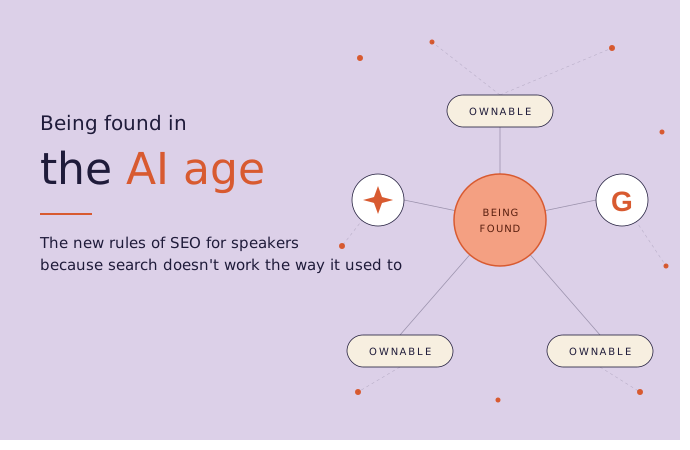
Where those three circles overlap is where your search visibility lives. That overlap is what AI platforms pick up, synthesise and repeat back when someone asks for a recommendation.
Four things you can do this month
If you want to start making the shift, here’s where I’d put your effort. In order.
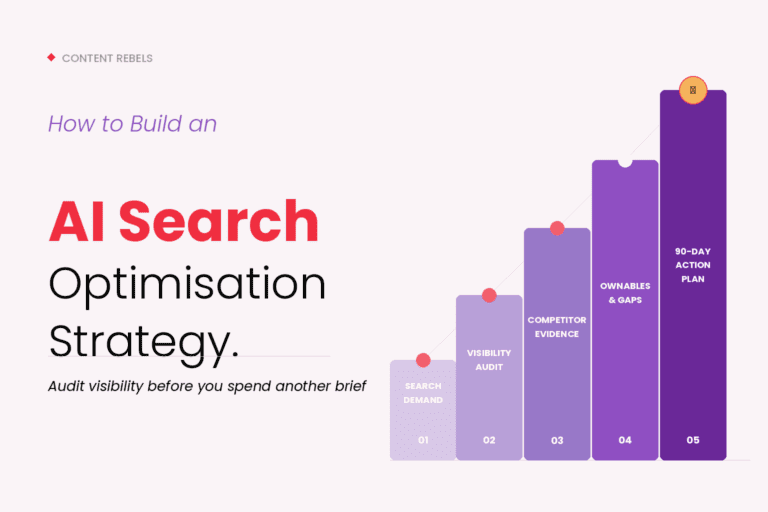
1. Understand your search demand and current visibility
Before you change a single word of copy, find out what bookers actually type when they’re looking for someone like you. A tool like Semrush will show you exactly how many people each month search “innovation speaker” versus “business innovation speaker” versus “innovation keynote speaker for conferences.” The variations matter enormously.
You’ll find gold in the long-tail phrases – the ones searched fewer times but by exactly the people you want in front of you. Terms like “leadership speaker for healthcare,” “resilience speaker for schools” or “innovation after-dinner speaker” are often overlooked, but they’re dripping with intent.
Then check where you currently rank for those terms and where you appear inside AI Search responses. That baseline tells you where the quickest wins are.
2. Align your owned channels to how bookers actually search
Your website is the one channel you fully own and fully control. If your homepage already converts well for people searching your name, leave it alone. Don’t break what’s working.
But do consider adding dedicated pages for the topics you speak on. Not a single “Topics” page with a paragraph each, but a proper page for “leadership speaker”, another for “resilience speaker”, another for “motivational speaker for healthcare” – whatever matches how your audience is searching. Give each one the space to explain your unique perspective, your credentials, the outcomes your keynotes deliver and who they’re designed for.
These pages act as landing pads for the bots. They don’t all need to be in your main navigation if that feels like clutter. They just need to exist on your domain, connected, crawlable and rich with the language bookers actually use.
3. Plan four new blog posts – and four new earned media moments
Your website pages describe what you do. Your blog posts prove it. One long, opinionated, genuinely thoughtful post on the future of leadership does more for your AI Visibility than ten generic “5 tips for better leadership” pieces, because the AI bots are hungry for nuance, context and human voice. The more distinctly you a piece sounds, the more the bots love it. It’s the great paradox of this moment.
Plan four blog posts that expand on each of your speaking topics – your genuine perspectives, your unusual takes, the things you’d argue at a dinner party.
Then plan four earned media moments to match. Podcast appearances, guest articles, interview features, digital PR. Because what others say about you is just as important to the AI’s picture of who you are as what you say about yourself. If three independent podcasts describe you as “one of the leading voices on change leadership,” the AI starts to treat that as fact.
4. Set up tracking
Most speakers have no idea whether they’re appearing in AI Search responses at all. That has to change. Set up tracking – through a tool like Semrush, or even just by regularly checking your Google Analytics for traffic coming from ChatGPT, Perplexity and Gemini – so you can see whether your efforts are moving the needle.
Without tracking, you’re guessing. With it, you’re iterating.
The uncomfortable truth… and the opportunity
Here’s the uncomfortable part: you can’t control what AI platforms say about you. You can’t demand to be on a shortlist. You can’t write your own entry in an AI Overview.
But, here’s the opportunity: you can influence the inputs. And right now, most speakers aren’t even trying. The bar for showing up in AI Search is currently much lower than most people realise, because the playbook is so new that the competition hasn’t caught up yet.
The speakers who’ll dominate the next five years are the ones who are treating this as a mindset shift, not a marketing tactic. They’re writing publicly. They’re showing up in media. They’re aligning what they say about themselves with how bookers search. They’re tracking and adapting.
The ones still relying on “it’s who you know” are going to find their networks shrinking faster than they expected – because even the people who already know them are now checking what AI says first.
The question isn’t whether AI Search will reshape how speakers get booked. It already has.
The question is whether you’ll be found.

Founder of Content Rebels | Proud marketing and strategy nerd