SEO isn’t dead – but SEO-only thinking is
If I see one more “SEO is dead” post, I think I’ll scream.
I get it – a lot has changed. But the conversation is so often framed in the least useful way possible: as a choice between clinging to old-school SEO or throwing everything out in favour of AI tactics.
That binary is not just wrong, it’s actively unhelpful.
I’m happy to tell you that SEO isn’t dead. Technical health still matters. Useful content still matters. Structure, relevance, authority and intent still matter.
But a lot of the thinking surrounding SEO is now too narrow for the search environment brands are operating in.
That’s the real issue.
The problem isn’t SEO itself. The problem is SEO-only thinking: treating search as though it still happens mostly in one environment, follows one discovery path and should be measured through one dominant set of metrics.
That frame no longer holds.
Search has become broader, messier and more fragmented across traditional search, AI search and discovery platforms. People are asking more complex questions, taking more winding paths and expecting faster, better answers. Google is evolving in response. AI tools are changing discovery behaviour. Social platforms are increasingly functioning as search engines in their own right.
So no, SEO is not dead.
But SEO-only thinking is no longer enough.
What people get wrong about this debate
The most common takes in this space tend to fall into two camps.
The first camp insists that nothing much has changed. Keep doing keyword research, publish SEO content, build backlinks, watch rankings, job done.
The second camp swings the other way. Everything is broken. AI changes everything. Traditional SEO is irrelevant. Start again from scratch.
Neither of those positions is especially useful if you are the person inside the business who has to make sense of what to do next.
And let’s be honest… most in-house teams don’t need more noise. They need clarity.
That is exactly where many teams are getting stuck right now. They can see that search behaviour is shifting, old reporting models are becoming less complete and visibility is showing up in different ways. But the discourse around it is still too simplistic.
So let’s take a breath and look at what is actually happening.
What still matters from SEO
A sensible critique of SEO-only thinking starts by acknowledging what still matters.
Plenty of traditional SEO principles remain highly relevant. Understanding search demand still matters. Technical health still matters. Clear site architecture still matters. Relevance still matters. Good content still matters. Authority still matters.
None of that has suddenly stopped being useful because AI tools exist.
If your site is slow, messy, thin, confusing or structurally weak, that’s still a problem. If your content doesn’t genuinely help people, that’s still a problem. If your brand has no depth or credibility in the topics it wants to be found for, that’s still a problem.
The fundamentals haven’t vanished.
What has changed is the environment those fundamentals are operating within.
SEO used to be treated, in many organisations, as a relatively self-contained channel. A specialist function with its own tactics, its own metrics and its own optimisation logic. That model made sense when search was more stable and more centralised.
It makes less sense now.
Where SEO-only thinking breaks down
SEO-only thinking tends to assume three things:
- There is one primary search environment worth optimising for.
- Discovery mostly happens through a familiar set of mechanics: queries, rankings, clicks and webpages.
- Success can be understood mainly through rankings, traffic and perhaps conversions from organic sessions.
That is the frame that is breaking down.
Search no longer behaves like a single environment, even if we still try to measure it that way. People still use Google, of course. But they also move between AI tools, forums, video platforms, social platforms and review environments as part of the same search journey.
Discovery is no longer one-step. People don’t just type a query, click a result and make a decision. They compare, refine, ask follow-up questions, sanity-check answers, look for social proof and seek context from multiple sources.
And visibility is no longer expressed in just one way. Brands can now influence search journeys before the click, around the click or without a click at all. They can be surfaced, mentioned, summarised, cited, recommended or remembered.
That doesn’t mean traffic no longer matters. It means traffic is no longer the only useful lens.
This is where SEO-only thinking becomes too narrow. It encourages teams to keep asking a limited set of questions: What do we rank for? How many visits did we get? Which page moved up? Which page moved down?
Those questions still matter. They’re just no longer enough to guide strategy anymore.
The real shift is human search behaviour
Much of the commentary about search still treats this as a platform story. Google changed. AI arrived. Algorithms evolved. Therefore, tactics must change.
But that’s only part of the picture – the deeper shift is behavioural.
The way people search has been evolving for a long time. We moved from passive information discovery to simple digital lookup. Then from individual words to keywords and questions. Then from questions to more conversational, layered and iterative searching.
Now, search often happens across multiple steps and multiple environments.
A person might begin with Google, skim two articles, open Reddit, ask ChatGPT to explain a concept, watch a YouTube video, then return to search with a more specific question. Or they might start in TikTok, move to Google, compare options on a brand site and use an AI tool to pressure-test their shortlist.
What used to be measurable as a single query is now spread across multiple interactions, platforms and moments.
Those journeys are not always neat. They are exploratory, fragmented and context-driven. People expect direct answers, but they also expect nuance. They want speed, but they also want confidence. They want relevance, context and proof.
That is why this shift can’t be solved by simply bolting on a few AI tactics.
The platforms changed because the way people search changed. And search strategy now needs to reflect that broader reality.
The four strategic shifts that matter
This is where the traditional SEO frame starts to show its limitations and a broader strategic model becomes necessary.
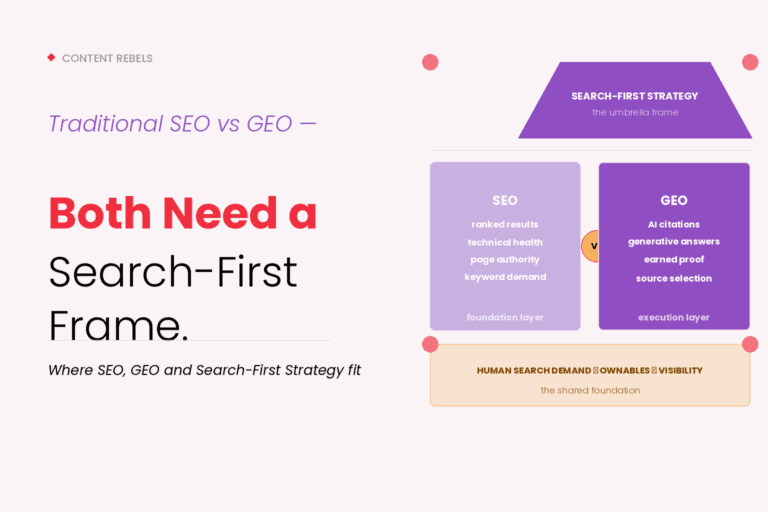
This isn’t SEO vs something new. It’s SEO… expanded. The shift isn’t from SEO to no SEO. It’s from SEO-only thinking to a broader Search-First way of thinking.
In practice, that means four important transitions.
1. From keywords to semantics
Keywords still matter. But an overly keyword-led strategy often flattens how people actually search.
People don’t experience their needs as neat keyword sets. They move through topics, questions, anxieties, comparisons and adjacent concerns. They search with nuance. They refine. They circle. They ask things in different ways depending on where they are in the journey.
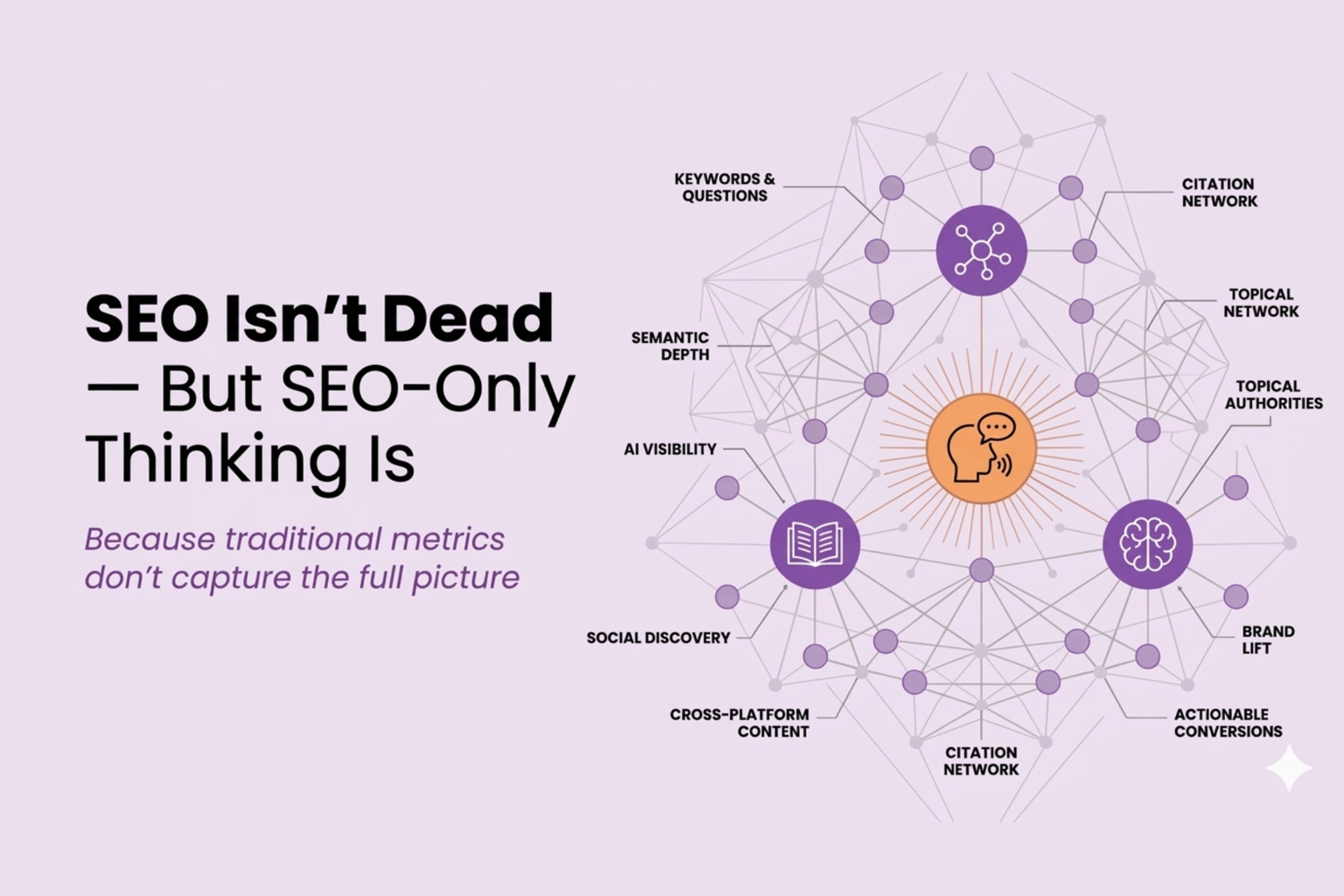
That means brands need to think beyond keyword targeting alone and toward semantic depth: the broader topic context, the connected questions and the real search landscape surrounding a need. It’s not just about what people type, but what they’re really trying to figure out.
In other words, the question is no longer just, “What keyword do we want to rank for?” It is, “What topic space are people exploring, and how fully do we show up within it?”
2. From backlinks to broader authority signals
Backlinks still matter. But they’re no longer the only authority signal worth caring about.
Brands now need to think more broadly about mentions, references, expert contributions, contextual relevance and the signals that help them become more credible and more retrievable across the wider search ecosystem.
That includes data-led mentions and authority built through being present in the right conversations, not just linked in the right places.
This is one of the most misunderstood shifts in modern search strategy. Not because links are irrelevant, but because authority now compounds through a wider mix of signals.
3. From tech optimisations to platform-specific tactics
Technical optimisation remains important, but it’s no longer the full story.
Different platforms reward different behaviours, formats and strengths. What helps content perform in Google isn’t always what helps it gain traction in YouTube, Reddit, TikTok or AI-generated search experiences. A page that is technically sound may still be invisible in the places where search journeys are actually unfolding.
That means strategy has to account for platform-specific tactics without losing sight of the bigger picture.
This is another reason SEO-only thinking struggles. It tends to over-prioritise the website as the only meaningful battlefield.
4. From static playbooks to experimentation
The old model of search strategy often assumed a relatively stable planning cycle. Research the terms, build the content plan, optimise the pages and report on the rankings. That kind of static playbook is becoming less reliable.
Search behaviour is changing too quickly. Platforms are evolving too quickly. Discovery patterns are too fluid.
The teams winning at search right now aren’t the ones with the most polished annual plan. They’re the ones with a clear strategic frame and the flexibility to experiment within it.
The answer isn’t chaos. It’s not random acts of content. It’s structured experimentation inside a clear strategic model.
What better thinking looks like
This is where Search-First Strategy becomes more useful than SEO-only thinking.
Search-First Strategy starts with human search demand. It looks at what people are actually searching for, how they are searching, what questions surround those searches and what adjacent concerns shape the journey.
From there, it identifies the topic spaces a brand can credibly own.
We call those spaces Ownables.
An ownable is not just a keyword or a blog topic. It’s a broader authority space the brand wants to be known for and consistently associated with over time.
It’s a space your brand earns the right to lead.
That matters because one of the biggest problems in modern marketing is fragmentation. Teams create pages, campaigns, posts and assets across different channels without a shared strategic centre. The result is lots of activity, but not much compounding authority.
Ownables create that centre.
Once Ownables are clear, better thinking leads to connected content ecosystems. Not isolated articles or random bursts of thought leadership, but ecosystems.
That might include core commercial pages, educational content, expert insights, founder or spokesperson commentary, earned visibility and distribution across the channels where relevant search behaviour is already happening.
This is where a Search-First Strategy process becomes useful. It helps teams see how their content, expertise and distribution should connect, rather than treating every asset as a standalone job.
It also encourages a broader view of success.
Yes, rankings and traffic still matter. But so do visibility, mentions, citations, topical authority, qualified demand and the strength of the brand’s presence inside the conversations people are actually having.
Why this matters commercially
It’s easy for this conversation to become abstract. So let me make it concrete.
When brands rely too heavily on narrow SEO logic, they often struggle with the same set of problems. Non-branded discovery becomes harder. Organic performance feels unstable. Paid channels end up carrying too much of the demand burden. Content gets produced, but authority doesn’t build. Traffic comes in, but it’s not always the right traffic.
And internally? Teams are left trying to explain why the numbers don’t tell the full story anymore. That’s not a fun conversation to have with your CMO or CEO.
A broader Search-First approach helps address those pressures because it focuses less on isolated wins and more on building structured authority around the topics that matter commercially.
That’s what improves discoverability, supports better-qualified demand and gives in-house teams a stronger strategic story to tell internally.
The reframe
So let’s retire the lazy headline.
SEO is not dead. But SEO-only thinking is no longer enough. Don’t throw out the fundamentals. Keep the parts of SEO that still matter: technical quality, search demand analysis, useful content, intent alignment, relevance and authority. Then expand the frame.
Search no longer happens neatly in one place. Visibility no longer shows up in one way. Search journeys no longer unfold in one step. Strategy needs to reflect that.
The more useful model now is Search-First Strategy: a broader, more adaptive framework built around human search demand, Ownables, connected ecosystems and visibility across the full search landscape.
Don’t abandon SEO. Just stop asking it to carry the whole load on its own.
If your team is trying to make sense of that shift, a Search-First Strategy Needs Assessment can help clarify where your current approach is still working, where SEO-only thinking is starting to limit you, and where your brand should focus next.
Book a Search-First Strategy Needs Assessment with Sarah Spence.

Founder of Content Rebels | Proud marketing and strategy nerd