Why a Search-First Strategy is the antidote to search chaos
Let’s face it… search has changed. Big time.
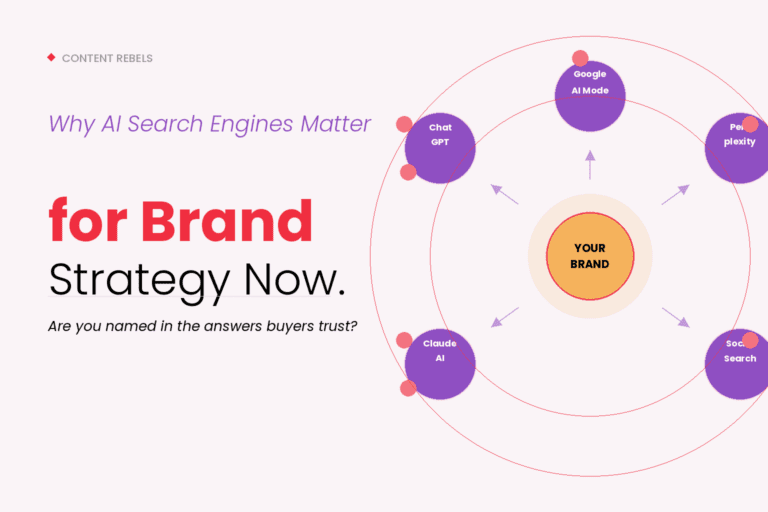
Organic traffic that once felt stable is becoming less predictable. Google’s Gemini-powered AI responses, AI Overviews and AI Mode are expanding rapidly (and so is their usage). At the same time, AI tools like ChatGPT, Claude, Grok and Perplexity are giving Google real competition, as more people go straight to their preferred AI platform to search. Meanwhile, social channels like TikTok, YouTube and Reddit are increasingly behaving like search engines in their own right.
Inside brands and businesses, this shift has quickly created pressure. Leadership teams are telling their teams to “make AI work” and “figure out AI Search”. There are new acronyms in the mix, like GEO, AEO and SXO, to figure out. LinkedIn is flooded with declarations that SEO is dead and this is the end of digital marketing as we know it. Panic much?!
The most common response I’ve seen over the past 18–24 months has been “QUICK! We need a new AI Marketing strategy!!” I’ve had more calls with potential clients looking for help with AI Search than I can count… but almost every conversation goes the same way:
“So you’re looking for help with AI Search?”
“Yes. Our CEO is obsessed and we need to figure out how to get more traffic from ChatGPT, Gemini, Perplexity etc.”
“Ok, great. How much traffic are you generating from AI platforms right now?”
“….”
“No worries. And how has your SERP Feature profile changed?”
“….”
“All good. So, how much has your Traditional Organic traffic dropped by and have you investigated where the drops are coming from?”
“Oh, umm… not that much and, no we haven’t… but we’re worried about what’s going to happen.”
Look, I get it. The hype is real(ly exhausting). But I’m here to tell you that you DON’T need to suddenly spin up a whole separate strategy just to win in AI Search.
What you need is to understand how your ideal audience’s search behaviour is changing and then calmly respond to those changes with unique, thoughtful and data-backed owned and earned marketing activity.
In other words, what you need is a Search-First Strategy.
What is a Search-First Strategy?
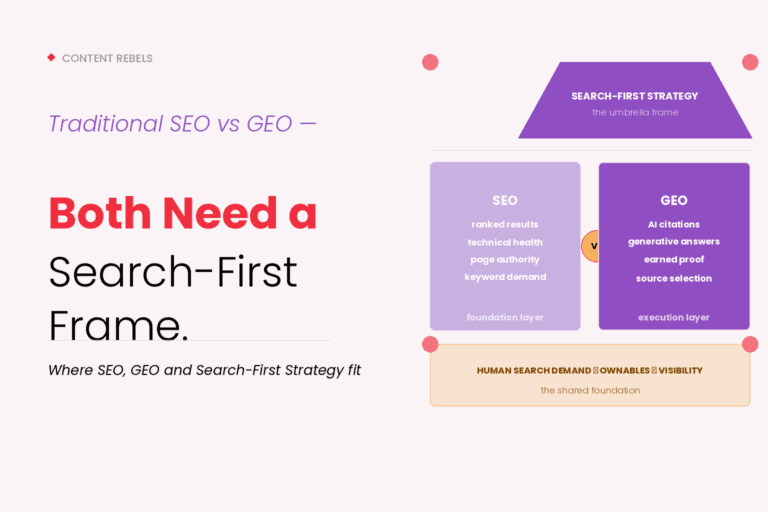
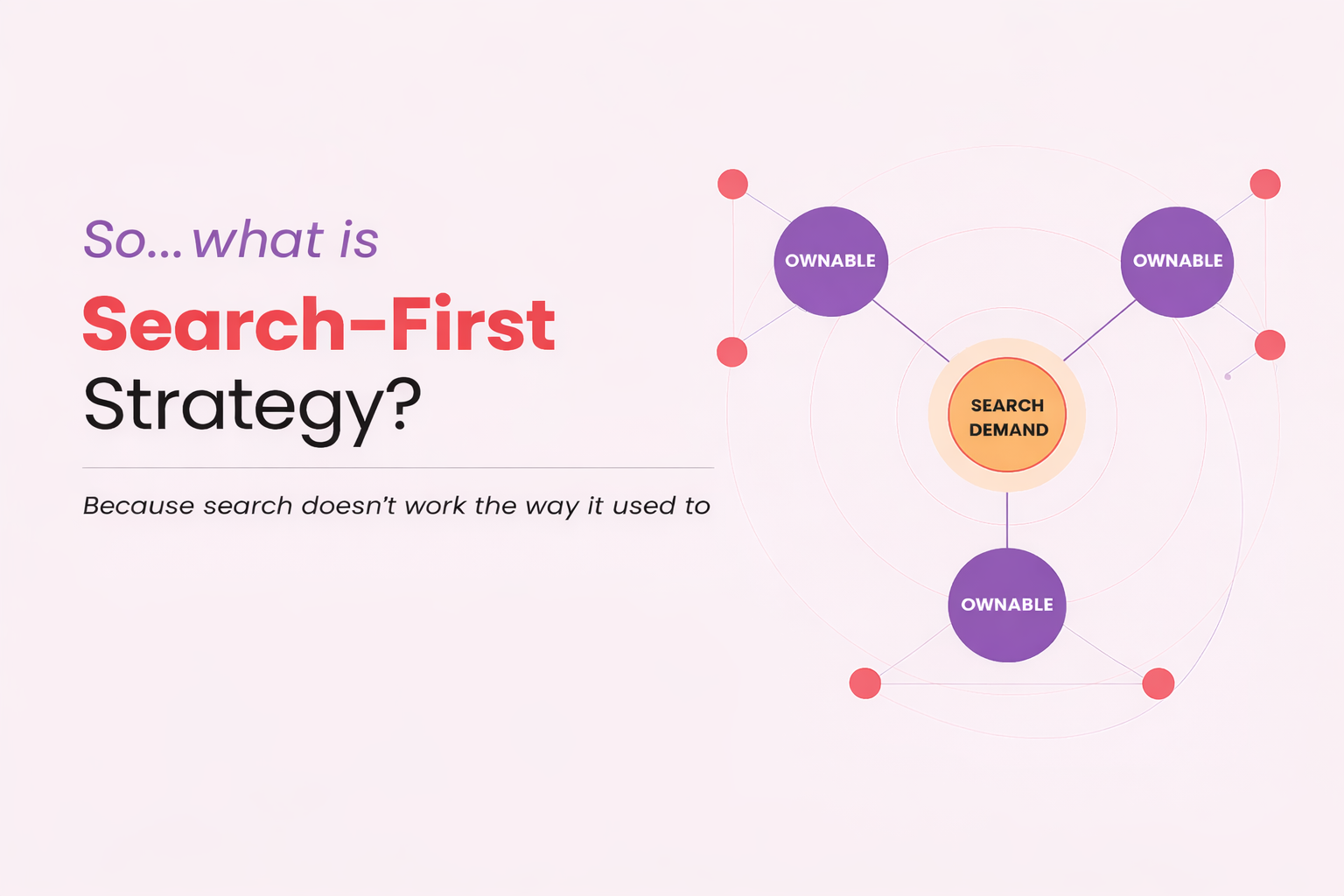
Search-First Strategy is a modern strategic framework for helping brands become discoverable, retrievable and citable across traditional, AI and social search by starting with human search demand, defining the topic spaces they can own and building connected content ecosystems around them.
Today, the search environment is more complex
And I don’t just mean technically. I mean strategically.
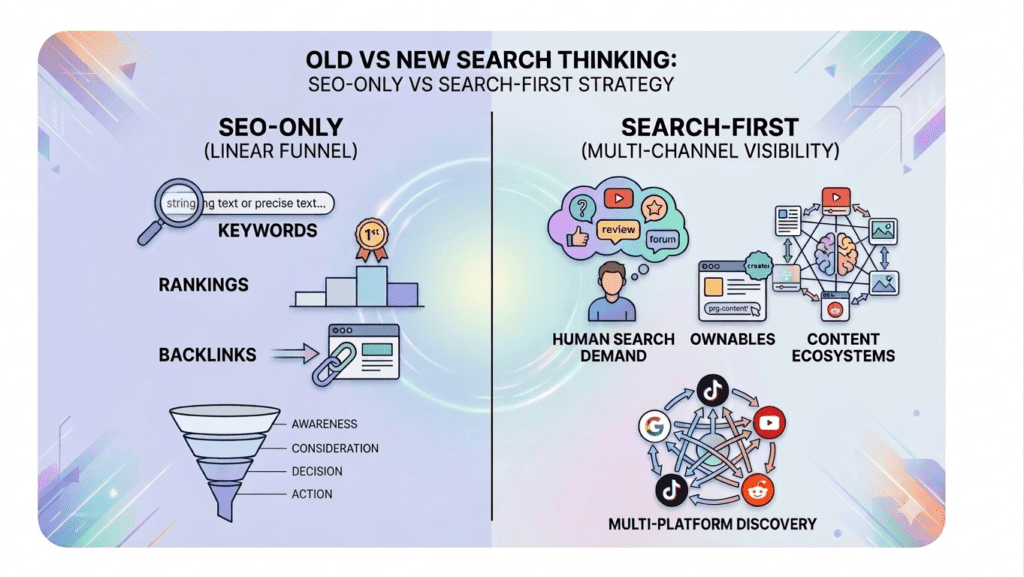
For years, in-house marketing teams worked with a relatively clear playbook. Identify target keywords. Optimise content. Earn backlinks. Measure rankings and traffic. Rinse, repeat. It wasn’t glamorous, but it worked because search behaviour was relatively predictable.
Now? Less so.
And inside your organisation, the pressure is building. Leadership wants answers. The industry is contradicting itself loudly. Some voices say everything has changed. Others insist nothing has.
Neither extreme is particularly useful when you’re the one who has to actually make the decisions.
What in-house teams need isn’t another layer of hype or another channel-specific playbook. It’s a clearer way to think about search itself. That’s exactly what Search-First Strategy is designed to provide.
The real shift: human search behaviour has changed
Here’s the thing most of the AI search conversation misses. The platforms aren’t the real story. The behaviour is.
Think about how search has evolved. We went from passively stumbling across information to typing simple words into a search bar, to crafting specific keyword strings and questions. Then search became conversational. And now? It’s layered, exploratory and fragmented across platforms.
A single research journey might look like this: you Google something, skim an article, ask an AI tool to explain a concept, watch a video, then go back to Google with a more specific question. What used to be one interaction is now a whole process.
People expect faster answers, richer explanations and more context. AI search has accelerated those expectations, but it didn’t create them.
Once you look at search through this lens, the strategic response becomes a lot clearer. The issue isn’t that one platform has changed. It’s the way people search that has evolved, and search strategy needs to evolve with it.
So, what is Search-First Strategy?
OK, let’s dive in.
Search-First Strategy is a strategic framework designed to help brands navigate the modern search landscape by aligning content, authority and visibility to how their ideal audiences actually search today. At its simplest, Search-First Strategy starts with deep research into the search demand of what any brand does, sells or solves, before leveraging those insights to shape what the brand creates, publishes and distributes.
It begins by analysing demand data to understand what people are searching for, how they search and the questions, comparisons and adjacent problems that surround those searches. From there, it identifies the topic spaces a brand can credibly own. Content and distribution are then mapped across owned and earned channels so the brand becomes more discoverable, retrievable and citable wherever search happens.
In practice, the process looks like this:
First, you analyse how people are actually searching within your category. Not just the obvious keywords – the questions, the problems, the comparisons, the adjacent topics. These are often referred to as ‘fan-out queries’.
From there, you identify the spaces your brand should own. We call these ‘Ownables’ – and I’ll come to those in a moment.
Once those spaces are clear, you design content marketing ecosystems that support them: core pages, educational content, expert insights and organic and paid distribution across owned and earned channels.
Finally, you track visibility and momentum – not just rankings – and use that rich data to inform how you evolve the content marketing ecosystems.
The outcome? Your brand shows up consistently when people explore a topic you’ve deliberately claimed. You become easier for audiences – and for traditional and AI search systems – to discover, retrieve and reference.
That’s the real purpose of Search-First Strategy. Not to chase every shift in search. But to build structured authority in the places and topics that actually align with what you do, sell and solve.
Starting with human search demand
This is the shift that changes everything.
Most marketing plans start internally. They begin with products, campaigns or brand messaging – and content gets produced to support those priorities. Sound familiar?
Search-First Strategy reverses that order.
Instead of starting with what the brand wants to say, you start with what people are already searching for. And I don’t just mean keywords. I mean the full landscape of demand: the problems your customers are trying to solve, the stages of understanding they move through, the clusters of questions that surround a topic.
When you understand that landscape properly, you can see where meaningful authority can actually be built – and where your brand has a genuine right to lead.
Understanding Ownables
This is one of the concepts I’m most passionate about, so bear with me.
An Ownable is not a keyword. It’s not a blog topic. It’s not even a content pillar – though it’s related.
An Ownable is a strategic topic space your brand wants to be known for, associated with and sought out for over time. It’s broader than a pillar. It’s an authority territory.
Most organisations already use content pillars to organise their editorial calendar. Ownables go a step further. They represent the areas where your brand wants to consistently contribute expertise, insights and guidance – across channels, over time.
This distinction matters more than it might seem. One of the biggest challenges I see in modern marketing is fragmentation. Different teams producing different content across different platforms, with no shared strategic centre. The result? Authority never compounds. You’re always starting from scratch – campaign by campaign, or launch by launch.
Ownables fix that. They give your team a shared focus – not just a shared publishing theme, but a shared authority space within which every marketing, sales and customer team member can confidently focus their efforts. Over time, that’s what allows trust, visibility and relevance to build.
Building content marketing ecosystems
Once your Ownables are defined, the next step is building ecosystems around them. And this is where Search-First Strategy gets really tangible.
It’s not about publishing more content. It’s about connecting your marketing activity and the content you create within it, so it actually reinforces itself. When I’m talking about ‘content marketing ecosystems’ here, I’m talking about far more than just blog pages. A rich ecosystem covers paid search, paid social, organic social, email, SMS, customer comms… the whole shebang.
For example, an ecosystem might include:
- core service or category pages that are focused on driving consideration for a product group/service
- individual product or service pages that focus on selling
- pillar posts that go into detail on the problem that the service/products can solve
- cluster posts that dive further into the problems/solutions, often focused on specific long-tail search queries
- organic social posts and videos that further distribute the key points from the posts and key benefits from the products/services
- paid media placements aligned to the search queries that the core and product pages, as well as the posts, are focused on
- email nurture sequences built around the purchase or enquiry pathways of the specific services/products
As you can see, commercial-intent pages matter here too – and this is something teams often overlook. Search demand doesn’t only exist at the educational or awareness stage. It also shows up when people are comparing options, evaluating solutions and getting close to a decision. Your content marketing ecosystem needs to support that whole journey because, if it doesn’t, not only will your ideal customers/clients not be able to confidently choose you, neither will the search bots.
When these elements are mapped intentionally, the brand begins to show up consistently wherever that topic appears – across traditional (Google, Bing, Yahoo, etc.), AI (ChatGPT, Gemini, Claude, etc.) and social (TikTok, Meta, YouTube, etc.) search. Visibility becomes cumulative, intentional and compounding, not fragmented and reactive
One of the most common things I hear from teams after going through a Search-First Strategy mapping process is: ‘We already have so much content. We just didn’t realise how disconnected it was.’
That clarity alone is often the most valuable outcome.
Measuring success differently
Search-First Strategy also means rethinking how you measure what’s working.
For years, SEO reporting has centred on rankings and traffic. Those metrics still matter – I’m not suggesting you ignore them. But they don’t capture the full picture of how modern search visibility actually works.
Today, authority shows up in places traditional SEO reporting often misses: mentions in trusted publications, citations in AI-generated answers, growing brand recognition within a topic area and higher-quality traffic from people who already understand what you do.
The goal isn’t just more visitors. It’s a stronger presence in the conversations people are having when they search. When that presence grows, traffic and conversions tend to follow – but with stronger context, stronger trust and stronger intent behind them.
Why this goes beyond SEO-only thinking
Let me be clear: I am not here to tell you SEO is dead. It isn’t. Technical health, search intent and relevance still matter enormously.
But treating SEO as the entire strategic frame for search? That’s where it gets limiting.
Traditional SEO asks important questions. What do we want to rank for? How do we improve visibility? How do we drive relevant traffic? Still valid. Still worth asking.
Search-First Strategy adds a broader layer on top. It asks: What is our audience actually searching for across their full journey? Which topic spaces should we own? How do we build authority that shows up across search engines, AI tools and discovery platforms?
SEO is still part of the answer, but it’s no longer the entire framework.
What Search-First looks like in practice
Here’s what I want you to take away from this section: Search-First Strategy rarely means starting from scratch.
More often, it means getting clearer and more deliberate about what you already have.
It might look like reorganising existing content around clearer Ownables. Strengthening one strategic ecosystem rather than spreading effort thinly across too many themes. Connecting educational content more deliberately to your commercial pages. Bringing recognised voices into your content to deepen credibility.
It might also mean deciding what NOT to create. That’s often the hardest part – and one of the most liberating.
When teams have a better strategic frame, they stop reacting to every change in search and start making more confident decisions about focus, investment and priority. That shift in confidence is something I see happen consistently when teams go through this process properly.
The practical takeaway
Search will keep changing. New platforms will appear. New formats will emerge. New acronyms will flood your LinkedIn feed.
You don’t need to chase all of it.
What you do need is a clearer framework for deciding what actually matters – and where your brand should focus its energy.
That’s what Search-First Strategy gives you. A way to understand how human search demand is evolving, which topics your brand should genuinely own, and how to build authority around those spaces over time.
For many of the in-house teams I work with, that clarity is the difference between constantly reacting to change and actually navigating it with confidence.
If you’re working through these questions inside your organisation right now – and you want to step back, see the landscape more clearly and figure out where to focus – let’s talk.
Book a Search-First Strategy Mapping Session with Sarah.

Founder of Content Rebels | Proud marketing and strategy nerd